
What makes group coaching different from simply bringing several people together for a discussion? How can a coach help participants learn from one another while ensuring that each person makes progress toward their own goals?
In this recorded iNLP Center webinar, we introduce CircleShift, our six-stage group coaching framework designed to bring structure, shared discovery, individual awareness, and meaningful action into the group coaching experience.
Whether you’re an experienced one-on-one coach looking to expand your services, a facilitator interested in developing coaching skills, or someone new to the coaching profession, this webinar offers a practical introduction to what effective group coaching can look like.
You’ll explore the difference between group teaching and group coaching, discover the six stages of CircleShift, and learn a simple questioning tool that can improve almost any group conversation.
Watch the CircleShift Group Coaching Webinar
What Makes Group Coaching Different?
Group coaching is more than individual coaching delivered to several people at the same time. It also differs from teaching a class, leading a workshop, or facilitating a traditional discussion.
In group teaching, the leader generally provides information, explanations, and instruction designed to help participants achieve a shared learning objective. In group coaching, the focus shifts toward helping participants explore their own experiences, clarify personally meaningful outcomes, and discover new possibilities through interaction with others.
Consider a group focused on building professional confidence. One participant may want to feel more comfortable speaking during meetings. Another might be working on setting boundaries, while a third wants to develop confidence when making decisions.
Although everyone is exploring the same general topic, their personal goals are different. The group coach’s responsibility is not to provide one solution that everyone must follow. Instead, the coach creates opportunities for reflection, conversation, and individual discovery.
This distinction is central to the CircleShift philosophy: the group creates additional opportunities for learning, while each participant retains ownership of their own coaching experience.
For a deeper exploration of the two formats, read Group Coaching vs. One-on-One Coaching: Why Professional Coaches Benefit From Both.
Introducing the iNLP CircleShift Group Coaching Framework
One of the challenges of facilitating group coaching is balancing two important needs: creating a meaningful collective experience while supporting the individual development of every participant.
Without a clear process, group conversations can drift into advice-giving, become dominated by a few participants, or end with interesting discussions but little practical application.
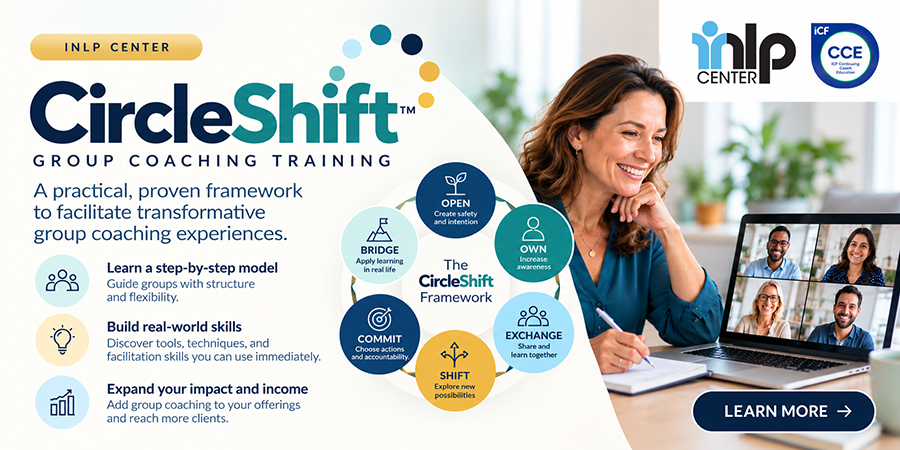
The iNLP CircleShift Framework provides a repeatable six-stage approach that helps coaches navigate these challenges. It is designed as a flexible process rather than a rigid script, allowing the coach to respond to the people and situations that emerge during a session.
The Six Stages of CircleShift
1. OPEN — Create the Coaching Space
Every meaningful group coaching experience begins with a productive environment. During OPEN, the coach establishes the session’s purpose, creates group agreements, discusses participation and confidentiality, and helps participants prepare to engage.
2. OWN — Clarify Individual Outcomes
Even when the group shares a common topic, participants may have different goals. OWN helps each person identify what matters to them and what they would like to gain from the coaching experience.
3. EXCHANGE — Facilitate Shared Discovery
EXCHANGE brings the group’s collective experience into the coaching conversation. Through thoughtful questions, reflection, and peer perspectives, participants can explore ideas and recognize patterns they might not have noticed independently.
4. SHIFT — Explore New Possibilities
During SHIFT, participants examine assumptions, consider alternative perspectives, and explore new choices. Coaches may introduce appropriate coaching exercises or NLP-informed techniques to support awareness while preserving each participant’s right to decide what is useful.
5. COMMIT — Choose Meaningful Action
Insight becomes more useful when participants decide how they want to apply it. COMMIT helps each person identify a realistic, personally meaningful next step rather than following actions prescribed by the coach or the group.
6. BRIDGE — Transfer Learning Into Everyday Life
BRIDGE connects the coaching experience to the real world. Participants explore where they can apply their learning, how they will recognize progress, and what they might bring back to a future coaching session.
Together, these stages create a process that supports both individual development and collective learning.
The CircleShift Learning Cycle: Self → Group → Self → Real World
A central concept introduced in the webinar is the movement between individual and collective awareness.
Participants begin by reflecting on their own experiences and goals. They then explore the perspectives and experiences of others, gaining ideas and awareness that may expand their understanding.
From there, each participant determines what the shared learning means for them personally and chooses how to apply it beyond the session.
This is what makes group coaching particularly valuable. A participant may discover something important through another person’s experience without having the same circumstances, challenges, or desired outcome.
The group contributes to the discovery, but the individual determines what to do with it.
Learning Activity: From Giving Advice to Asking Coaching Questions
The webinar introduces a practical group coaching scenario involving confidence and communication.
Imagine facilitating a group focused on building confidence. One participant shares:
“I keep planning to speak up, but I never do.”
Another participant immediately responds:
“You just need more discipline.”
This is a familiar moment in group conversations. Someone describes a challenge, and another person quickly offers a solution.
Although the advice may be well-intentioned, it can shift the conversation away from the individual’s actual experience. The participant may need an opportunity to explore what is happening before deciding whether discipline—or something entirely different—is relevant.
A coach could immediately provide three strategies for speaking up and ask everyone to practice them. Alternatively, the coach might respond with curiosity:
“Before we jump to solutions, what is happening for you in those moments?”
The second approach opens an opportunity for exploration. The participant might discover that uncertainty, fear of criticism, or another concern influences their behavior.
The coach can then invite the wider group to reflect on the assumptions people make in similar situations, without requiring everyone to reach the same conclusion.
For example, the conversation could move through three CircleShift stages.
OWN: What tends to happen just before you decide to stay quiet?
EXCHANGE: What do others notice about the stories we tell ourselves in situations like this?
SHIFT: What other explanations or possibilities might be worth considering?
The purpose is not to decide that the participant’s original interpretation is wrong. It is to create enough space for curiosity that new choices become possible.
This illustrates a central coaching distinction: the coach guides the process rather than supplying the answers.
For additional techniques, explore How to Facilitate Group Coaching Sessions: 7 Essential Skills.
Your Takeaway Tool: Six Questions for Better Group Conversations
One of the practical takeaways from the webinar is a simple set of six questions based on CircleShift.
These questions can help coaches, facilitators, team leaders, and other professionals bring a more coaching-centered approach to group conversations.
OPEN: What would make this useful?
OWN: What matters most to you?
EXCHANGE: What are others noticing?
SHIFT: What else might be possible?
COMMIT: What step will you choose?
BRIDGE: Where will you apply it?
The questions are not intended to become a mandatory script. They serve as reminders of the different purposes a group conversation can fulfill.
For example, you might use OPEN and OWN to begin a professional development conversation, EXCHANGE and SHIFT to explore a shared challenge, and COMMIT and BRIDGE to help participants leave with meaningful next steps.
Over time, a coach learns when to move between these stages, when to spend more time exploring a particular issue, and when to allow silence or reflection.
The result is a conversation that is structured without being overly controlled.
Why Group Coaching Skills Require Practice
Understanding a framework is an important starting point, but facilitating a group also requires practical experience.
A coach must listen to multiple participants, recognize emerging themes, encourage inclusive participation, maintain appropriate boundaries, and respond to the unexpected directions a conversation may take.
At times, participants may disagree. Someone may dominate the conversation, while another may prefer not to speak. A participant might offer unsolicited advice or introduce a topic requiring sensitivity.
Effective group facilitation involves responding to these situations without losing sight of the group’s purpose or individual participants’ needs.
This is why professional group coaching training benefits from opportunities to practice coaching questions, experience group conversations, receive feedback, and reflect on one’s facilitation choices.
The goal is not simply to learn the names of techniques. It is to develop the awareness, judgment, and flexibility required to use them appropriately.
Who Can Benefit From Learning Group Coaching?
Group coaching skills can support professionals working in many different settings.
Life coaches may want to add group programs alongside individual client sessions. Executive and leadership coaches may facilitate professional development groups. Wellness and specialty coaches may bring together participants exploring related goals, while trainers and facilitators may want to incorporate more participant-centered coaching into their work.
Group coaching can also create opportunities for coaches to serve more people through structured programs. However, developing a successful group offering requires thoughtful decisions about group size, session length, participant experience, pricing, and professional boundaries.
For a closer look at the business side, see Is Group Coaching Profitable? Pricing and Income Examples.
Interested in Becoming a Certified Group Coach?
The iNLP CircleShift Group Coaching Certification Training provides a comprehensive learning path for professionals who want to develop their group coaching skills.
The training is built around the complete six-stage CircleShift Framework and includes foundational coaching skills, group facilitation, practical NLP-informed techniques, individual outcome clarification, group dynamics, program design, and real-world application.
The redesigned program includes eight modules of self-paced online coursework, live Zoom training sessions, weekly group coaching practice opportunities, trainer guidance, and a final group coaching demonstration integrated into the eighth module.
Students learn the necessary foundational coaching concepts and selected NLP techniques within the program itself. Previous participation in iNLP Center’s Life Coach or NLP training is not required.
The Group Coaching Certification Training carries 20 ICF Continuing Coach Education (CCE) hours and leads to an iNLP Center Group Coaching Certification upon successful completion of program requirements.
If you’re ready to develop a structured approach to facilitating groups, CircleShift offers an opportunity to learn the framework, experience group coaching in practice, and build the skills to create your own group coaching programs.
EXPLORE CIRCLESHIFT GROUP COACHING CERTIFICATION TRAINING
Continue Exploring Group Coaching
If you’d like to learn more after watching the webinar, these additional iNLP Center resources can help you take the next step.
Group Coaching vs. One-on-One Coaching explores how the two coaching formats differ and why offering both can benefit professional coaches.
Group Coaching Facilitation Skills examines practical techniques for leading conversations, balancing participation, and supporting group learning.
Group Coaching Prices: How to Set Your Rates provides guidance on pricing your own group coaching programs.
Group coaching brings people together to learn from one another. CircleShift gives coaches a practical way to turn that shared experience into individual awareness, meaningful choices, and real-world action.

Co-founder and CEO of iNLP Center
Hope is an accomplished businesswoman and entrepreneur with a passion for empowering others to achieve their full potential.
With a Bachelor of Fine Arts (BFA) from California State University, Fullerton, and postgraduate education at Harvard Business School, Hope brings a unique blend of creativity, business acumen, and personal development expertise to her endeavors.
Hope’s entrepreneurial spirit shines through in her establishment of the iNLP Center, which has become a leading provider of NLP training and life coaching certification programs.