

Advanced Mentor Coach Development & Competency Evaluation: Master Your Mentoring Skills in our ICF Mentor Coach Specialization Training
Advance your ability to develop other coaches with ICF Mentor Coach Specialization Training for the ACC & PCC Level. Focused on Evidence-Based Feedback, ACC-to-PCC Analysis, and Mentor Coaching Mastery
- 41 Hour Advanced Mentor Coach Training
- 21 Live Training Hours + 20 Independent Study Hours
- ACC BARS-to-PCC Marker Comparative Analysis
- Cultural Humility & Bias Elimination in Evaluation
- Individual & Group Mentor Coaching Skills
- Observed Mentor Coaching + Mentoring Supervision
- Live Capstone Competency Assessment
- For Coaches Pursuing the MCS Standard Pathway
- 100% Online & Self-Paced
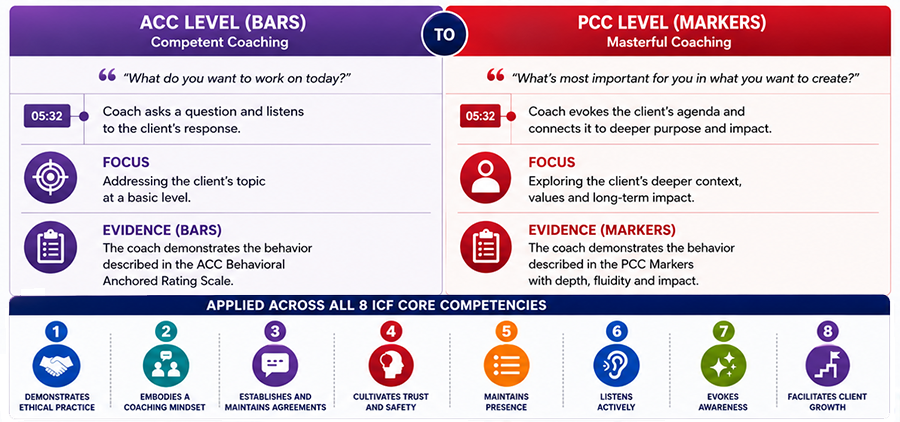
See the difference between competent coaching and masterful coaching
Identify subtle behavioral shifts that change coaching impact
Support conclusions with observable, time-stamped evidence
Elevate coaching standards through objective, fair evaluation
Facilitate meaningful coach development and growth

The Best Training Choice for Your MCS Credential
Effective mentor coach training should prepare you to do more than just identify coaching competencies. You need to be able to hear the difference between coaching levels, support your observations with behavioral evidence, communicate feedback in a way that promotes learning, and help each coach develop without turning mentor coaching into consulting or supervision.
Our ICF Mentor Coach Specialization Training combines independent study with live application so that you repeatedly practice the skills you are learning. From ACC BARS-to-PCC Marker analysis and bias-aware evaluation to observed mentor coaching and mentoring supervision, the program is designed to build both your knowledge and your ability to apply it.
ICF Mentor Coach Specialization Training Course Content
Mentor Coach Role Clarity → Ethical Contracting → Advanced Evaluation → Supervised Practice → Competency
Module 1: Course Introduction
Establish the professional foundation for your ICF Mentor Coach Specialization Training.
Begin by orienting to the training, its expectations, and the professional responsibilities involved in working with coaching recordings, transcripts, and developmental feedback. You’ll also complete the mandatory ICF Confidentiality Attestation, establishing confidentiality and ethical handling of coaching material as a foundation for everything that follows.
You’ll explore:
Module 2: The Mentor Coach Identity, Boundaries & Ethics
Learn to stay clearly in the role of mentor coach—even when the boundaries between coaching, teaching, consulting, assessment, supervision, and mentoring become complex.
One of the most important skills of an effective mentor coach is knowing exactly what role you are occupying and recognizing when you begin to cross into another modality.
Through the Modality Matrix, you’ll examine the distinctions among related professional roles and learn how purpose, authority, focus, and responsibility change from one modality to another.
You’ll then apply these distinctions to realistic ethical situations. The Ethical Boundary Risk Analysis and Modality Boundary Audit challenge you to identify subtle boundary crossings that may occur during mentor coaching.
The module also moves beyond simple one-to-one agreements. You’ll work with triadic and multi-role agreements, where organizations, sponsors, training providers, credentialing requirements, or other stakeholders may have interests in the mentor coaching relationship.
Finally, the Contract Stress-Test asks you to examine whether an agreement remains clear and ethical when real-world complications arise.
This is an especially valuable module because it teaches students not simply to know ethical principles, but to apply ethical judgment when roles and responsibilities become ambiguous.
You’ll develop the ability to:
Module 3: The Architecture of Feedback & Psychological Safety
Learn how to deliver feedback that coaches can actually hear, explore, and use.
Knowing what happened in a coaching session is only half of mentor coaching. The other half is communicating your observations in a way that facilitates development rather than defensiveness.
This module explores both the neurobiology and language of feedback, helping you understand why even accurate feedback can become ineffective when it threatens identity, competence, status, or psychological safety.
You’ll examine how seemingly small changes in language can shift feedback from judgmental to developmental.
In the Feedback Translation Matrix, you’ll practice transforming evaluative statements into evidence-based developmental feedback. Instead of simply telling a coach what was “good” or “wrong,” you’ll learn to identify observable behavior, connect it to coaching impact, and invite the coach into reflection.
The Audio Self-Reflective Practicum takes this further by allowing you to hear yourself delivering feedback and evaluate your own language, tone, assumptions, and mentor coaching presence.
The goal is a significant shift:
From: “Here is what you did wrong and what you should do instead.”
Toward: “Here is what I observed. What do you notice about its impact, and what might become possible if you experimented with another approach?”
You’ll learn to:
Module 4: Applied Structural Analysis — ACC BARS to PCC Markers
Learn to hear the difference between competent coaching and increasingly sophisticated coaching.
This is one of the most substantial components of the ICF Mentor Coach Specialization Training.
You begin with The Behavioral Continuum, examining coaching development as a progression rather than reducing competency evaluation to a checklist.
Then you’ll complete the ACC BARS-to-PCC Marker Evolution Series across all eight ICF Core Competencies.
For each competency, you’ll compare coaching demonstrations and analyze how coaching behavior changes as greater skill develops.
The work trains you to move beyond statements such as “This sounds like PCC coaching” and instead explain what you heard, where you heard it, why it matters, and what behavioral evidence supports your conclusion.
Rather than teaching coaches to “perform the markers,” the emphasis remains on understanding the quality of the coaching relationship and what the coach’s behavior makes possible for the client.
Across the eight competencies, you’ll practice how to:
Module 5: Cultural Humility, Inclusion & Bias Elimination in Evaluation
Strengthen your ability to evaluate coaching without confusing your own preferences with coaching competence.
Mentor coaches inevitably bring their own communication styles, cultural assumptions, professional experiences, expectations, and unconscious preferences into the evaluation process.
This module makes those influences visible.
Through Deconstructing Evaluative Bias, you’ll examine how bias can enter coaching observation and feedback—even when the mentor coach is attempting to be objective.
The Socio-Linguistic Contrast Analysis asks you to examine differences in language, communication patterns, directness, emotional expression, pacing, and interaction without automatically interpreting difference as deficiency.
Finally, the Bias-Stripping Framework Application provides a structured way to return your evaluation to observable coaching evidence.
The underlying question becomes:
“Am I evaluating the effectiveness of this coach—or how closely this coach resembles the way I would coach?”
That distinction is essential for developing coaches without creating copies of ourselves.
You’ll learn to:
Module 6: Group Mentor Coaching Dynamics & Remediation
Learn to facilitate development when several coaches are learning in the same room.
Group mentor coaching requires a different skill set from individual mentor coaching. The mentor coach must simultaneously attend to the coach receiving feedback, the learning needs of observers, psychological safety, participation, time, group dynamics, and competency development.
Through Group Blueprints & Remediation, the Group Mentor Coaching Structural Playbook, and Behavioral Remediation Design, you’ll learn how to create group experiences in which one coach’s session becomes a meaningful learning opportunity for everyone.
You’ll also explore what to do when a coach demonstrates a persistent developmental gap that cannot be resolved through general feedback alone.
You’ll develop skills for:
Module 7: Observed Mentor Coaching & Mentoring Supervision
Move from learning mentor coaching to demonstrating it repeatedly in practice.
This module is where the program becomes especially experiential.
Participants progress through a series of five observed mentor coaching sessions and five corresponding mentoring supervision sessions.
Rather than practicing once and receiving a final score, you’ll work through a developmental cycle:
Practice → Observation → Feedback → Reflection → Adjustment → Practice Again
During your observed sessions, you apply the mentor coaching skills developed throughout the program with faculty observing your work.
The corresponding mentoring supervision sessions then create an opportunity to examine your own choices as a mentor coach: what you noticed, what you missed, how you framed feedback, where assumptions may have entered, and what you want to do differently next time.
This creates something a lecture alone cannot provide: progressive mentor coaching experience with observation and feedback on your own performance.
Through repeated practice, you’ll strengthen your ability to:
Module 8: Final Quiz & Capstone Competency Assessment
Demonstrate that you can integrate what you’ve learned into professional mentor coaching practice.
The program concludes with both a knowledge assessment and the Final Capstone Competency Assessment.
The capstone is designed to evaluate integration rather than memorization.
You’ll be expected to demonstrate your ability to observe coaching, identify relevant evidence, exercise professional judgment, prioritize development, communicate feedback, and facilitate a productive mentor coaching conversation.
The capstone also includes a faculty evaluation defense, where you explain the reasoning behind your observations and developmental decisions.
The purpose is not to determine whether your interpretation perfectly matches a predetermined answer. It is to determine whether your professional reasoning is evidence-based, developmentally useful, ethically grounded, and defensible.
After successfully completing the required training components and final assessment, participants proceed to the program’s certificate request process.
The final assessment brings together your ability to:
Our Signature ACC BARS-to-PCC Marker Competency Evolution Series
One of the signature features of this program is a complete comparative-analysis series across all eight ICF Core Competencies. Rather than memorizing the markers, you will learn to recognize how coaching behavior actually evolves from ACC-level demonstration toward PCC-level mastery.
• Compare ACC and PCC coaching transcripts side by side
• Identify time-stamped behavioral evidence
• Cross-reference ACC BARS and PCC Markers
• Analyze changes in client ownership, partnership, awareness and growth
• Write evidence-based developmental recommendations
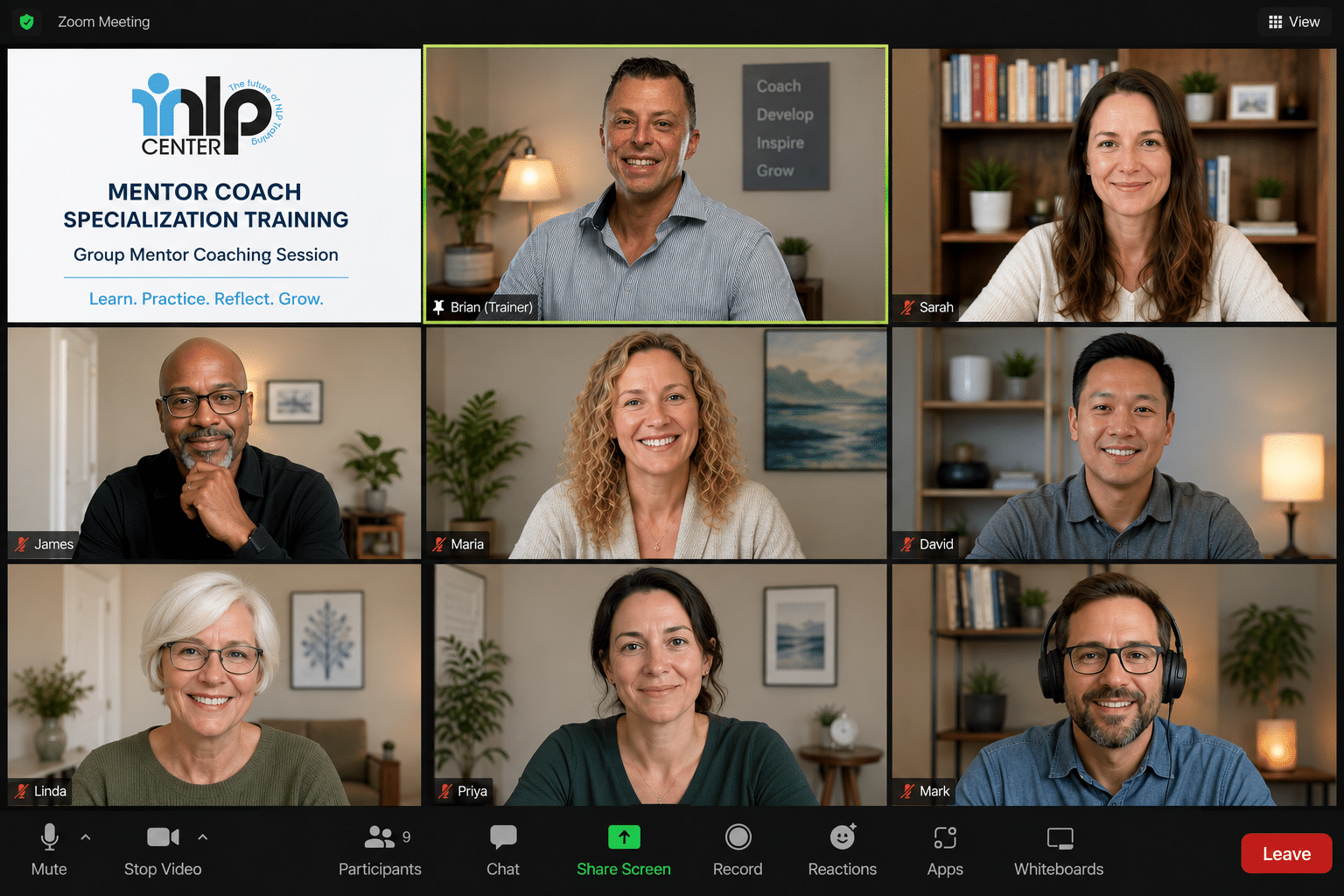
Flexible & Convenient, Self-Paced Training Schedule
Enroll Anytime → Start the Online Coursework → Jump into Live Zoom Sessions
✓ Enroll and Start Anytime
✓ Work Through the Online Coursework 24/7
✓ Attend the Live Sessions As You Can
✓ Finish in as Little as 3 Months
✓ Or, Take as Long as You Need!

Enroll Now and Start Immediately!
ICF Mentor Coach Specialization Training
| 41 Total Training Hours 21 Live + 20 Independent Study |
| ✓ Comprehensive MCS Online Modules |
| ✓ ACC BARS-to-PCC Competency Evolution Series |
| ✓ Cultural Humility & Bias Evaluation Training |
| ✓ Individual & Group Mentor Coaching |
| ✓ Observed Mentor Coaching + Supervision |
| ✓ Final Live Capstone Assessment |
 |
Or, INSTALLMENT PLAN for $861/mo x 4 months
> Click Here to Enroll <
Meet Your Trainer

MCC & MCS
Brian brings extensive experience as a life, business, and mental health coach, along with a strong entrepreneurial background, to his role as trainer for the Mentor Coach Specialization program. As an experienced coach and educator, he is passionate about helping fellow coaches deepen their skills, strengthen their professional judgment, and grow through thoughtful reflection and meaningful developmental feedback.
Brian’s teaching approach emphasizes self-awareness, competency development, and authentic coaching presence. He creates a supportive learning environment where coaches can examine their work, recognize opportunities for growth, and develop the confidence and skill to effectively mentor other coaches.
ICF Mentor Coach Specialization Training FAQs
Is ICF Mentor Coach Specialization
Training Right for You?