
Learn to Facilitate Powerful Group Coaching Sessions with iNLP Center’s Six-Stage CircleShift Framework
Build the skills to confidently coach groups, facilitate meaningful conversations, and help individuals create lasting change through shared learning. Our Group Coaching Certification Training teaches the complete iNLP CircleShift method, combining professional group facilitation, practical coaching skills, NLP-informed techniques, and real-world application.
Whether you’re an experienced coach expanding your services or new to coaching, this comprehensive training provides everything you need to learn and apply the CircleShift methodology.
- ICF-Accredited Group Coaching Training — 30 ICF CCEs*
- 8 Comprehensive Modules and 60 Learning Units
- Learn Our Signature Six-Stage CircleShift Framework
- 100% Online, Self-Paced Coursework
- Unlimited Live Zoom Training Sessions
- Weekly Group Coaching Practice and Demonstrations
- Practical NLP Techniques Taught Within the Course
- Individual Trainer Support and Feedback
- Lifetime Access to Your Learning Materials


Our Signature Six-Stage CircleShift Group Coaching Framework
The iNLP CircleShift Framework is the foundation of this certification training. It gives you a practical, repeatable approach to facilitating group coaching conversations while preserving the individual nature of each participant’s coaching experience.
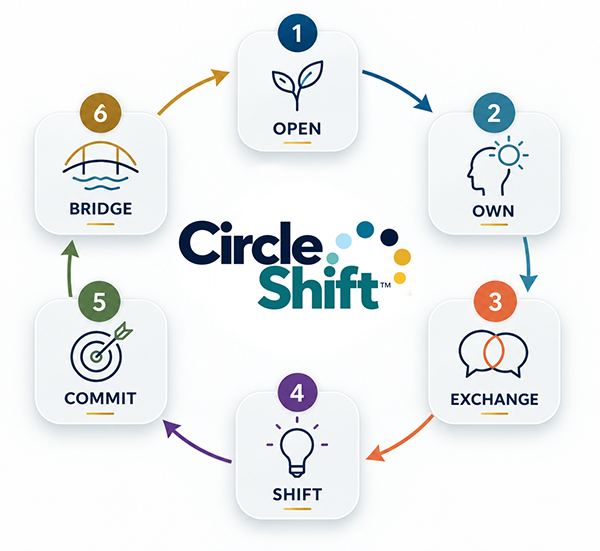
OPEN — Create the Coaching Space: Establish trust, agreements, purpose, and readiness for meaningful participation.
OWN — Clarify Individual Outcomes: Help each person identify what they want to explore or achieve.
EXCHANGE — Facilitate Shared Discovery: Use group questions, conversation, and diverse perspectives to expand awareness.
SHIFT — Explore New Possibilities: Guide participants through appropriate coaching exercises and NLP-informed techniques.
COMMIT — Choose Meaningful Action: Support each participant in identifying a personally relevant next step.
BRIDGE — Transfer Learning Into Everyday Life: Help participants apply their discoveries, reflect on their experiences, and return with new learning.
The central principle is simple:
Self → Group → Self → Real World
Each participant begins with a personal intention, learns through interaction with others, determines what the experience means for them, and carries their learning into everyday life.
Rather than simply learning how to manage a group conversation, you’ll develop a complete coaching process that can be used across personal, professional, and organizational settings.

CircleShift Group Coaching Certification Training Course Content
Coaching Foundations → OPEN → OWN → EXCHANGE → SHIFT → COMMIT → BRIDGE → Program Design
Module 1: CircleShift Coaching Foundations
Learn the essential foundations of professional coaching and discover what makes group coaching different.
Before learning to facilitate groups, you’ll develop an understanding of what coaching is, how it differs from teaching, consulting, mentoring, and therapy, and why the coaching relationship depends on curiosity, listening, professional boundaries, and client choice.
You’ll explore fundamental coaching skills such as asking open-ended questions, recognizing assumptions, reflecting what you’ve heard, and allowing participants to develop their own understanding. You’ll also learn a simplified iNLP coaching process that introduces the progression from establishing a coaching relationship to facilitating awareness and action.
The module introduces CircleShift as the organizing framework you’ll use throughout the training. Through practical examples, you’ll see how the six stages connect and why the process moves from individual awareness to group discovery and back to personal application.
You’ll learn to:
Module 2: OPEN — Create the Coaching Space
Learn to establish the conditions for meaningful group coaching before the exploration begins.
The opening of a group coaching session shapes how participants engage with one another. A successful coach creates clarity, establishes agreements, welcomes different personalities and communication styles, and helps participants understand what the group is there to accomplish.
During the OPEN stage, you’ll learn how to introduce a session, establish effective group coaching agreements, discuss confidentiality, and build rapport without pressuring participants to share more than they’re comfortable sharing.
You’ll also explore the differences between open groups, closed cohorts, organizational groups, and other group formations. Practical examples demonstrate how to structure both online and in-person openings while accommodating different participant needs.
The module concludes with an OPEN practicum in which you plan and rehearse the beginning of a group coaching session.
You’ll learn to:
Module 3: OWN — Clarify Individual Outcomes
Help every participant identify a meaningful personal goal within the shared group experience.
One of the defining principles of CircleShift is that participants may explore the same topic while pursuing entirely different goals.
For example, a group discussing professional confidence might include someone who wants to speak up during meetings, another who wants to establish stronger boundaries, and someone who wants to communicate more effectively with colleagues. A skilled group coach recognizes these differences instead of assuming everyone needs the same solution.
The OWN stage teaches you how to help participants clarify their personal intentions, explore what matters to them, identify relevant values, and define meaningful indicators of progress.
You’ll learn a simplified Outcome Specification process, practical intake and reflection methods, and questions that help participants distinguish desired outcomes from assumptions or vague intentions.
You’ll learn to:
Module 4: EXCHANGE — Facilitate Shared Discovery
Learn to use the collective experience of the group as a powerful resource for individual learning.
EXCHANGE is where group coaching becomes more than several individual coaching conversations taking place in the same room.
Through structured discussion, thoughtful questions, and shared reflection, participants begin to recognize patterns, explore different experiences, challenge assumptions, and discover perspectives they may not have considered on their own.
You’ll learn iNLP Center’s Group-Talk approach for facilitating conversations that involve the whole group. Rather than allowing one participant to dominate or directing every interaction through the coach, you’ll develop techniques that encourage balanced participation and meaningful exchanges among participants.
The module also addresses common challenges, including dominant voices, reluctant participants, unsolicited advice, disagreement, and conversations that drift away from the group’s purpose.
You’ll learn to:
Module 5: SHIFT — Facilitate New Awareness with Practical NLP Tools
Discover how to help participants explore new perspectives, choices, and possibilities using NLP-informed coaching techniques.
The SHIFT stage moves beyond identifying challenges and sharing experiences. It creates an opportunity for participants to reconsider familiar patterns, explore alternative interpretations, and experiment with different responses.
In this module, you’ll learn selected Neuro-Linguistic Programming (NLP) techniques from the beginning. No previous NLP training is required.
You’ll explore practical applications of reframing, perceptual positions, the New Behavior Generator, values exploration, resourceful states, guided reflection, and structured group brainstorming.
Each technique is presented with an explanation, demonstration, practical exercise, and guidance for adapting it to a group where participants have different personal circumstances.
You’ll also learn how to select appropriate techniques, seek participant consent, preserve individual choice, and recognize the limits of coaching.
You’ll learn to:
Module 6: COMMIT — Turn Awareness Into Individual Action
Help participants move from valuable insights to practical actions they choose for themselves.
A powerful group conversation can create new awareness, but meaningful coaching also helps participants decide how they want to use what they’ve discovered.
During the COMMIT stage, you’ll learn how to guide individuals toward personally relevant actions without prescribing what they should do.
You’ll develop questions that help participants make their next steps specific, realistic, and observable while considering their values, resources, responsibilities, and circumstances.
The module introduces a simplified ecology check, helping participants consider the possible consequences of a proposed action before committing to it. You’ll also explore how accountability can support progress without creating public pressure, competition, or unwanted disclosure.
You’ll develop skills for:
Module 7: BRIDGE — Extend Learning Beyond the Session
Learn how to connect group coaching insights to everyday experiences and ongoing development.
A group coaching session should not be an isolated event. BRIDGE connects what participants discover during coaching with opportunities to practice, observe, reflect, and learn between sessions.
This module introduces a self-contained version of iNLP Center’s Coach-Do approach. You’ll learn how to help participants design manageable real-world experiments based on their individual commitments.
You’ll explore simple reflection logs, indicators of progress, optional peer support, and ways to revisit previous learning without turning group coaching into a homework-driven training program.
You’ll also learn how to begin subsequent sessions by helping participants reflect on what happened when they applied their insights, what they discovered, and what they want to explore next.
You’ll learn to:
Module 8: Professional Group Coaching Programs, Practice & Final Evaluation
Bring all six CircleShift stages together to design, facilitate, and demonstrate your group coaching skills.
In this final module, you’ll learn how to create and manage professional group coaching programs, from identifying your ideal audience and selecting an appropriate group format to designing sessions, establishing pricing, and managing group dynamics.
You’ll develop complete 60-minute and 90-minute CircleShift session plans and explore practical approaches to online facilitation, participant engagement, and program management.
You’ll also integrate everything you’ve learned through coaching practice, observation, feedback, and a final group coaching demonstration. This gives you the opportunity to apply all six CircleShift stages in a complete coaching session and receive developmental feedback from your trainer.
You’ll learn to:
Flexible & Convenient, Self-Paced Group Coaching Training
Enroll Anytime → Complete Your Online Coursework → Practice in Live Zoom Sessions
✓ Enroll and Start Anytime
✓ 100% Online & Self-Paced
✓ Weekly Group Coaching Practice and Demonstrations Included
✓ Trainer Guidance and Feedback
✓ Lifetime Course Access
Available Live Session Each Week – Attend as you like:

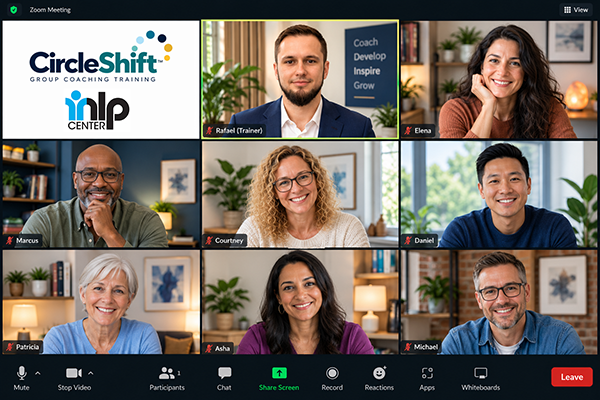
Our blended learning format combines independent study with live coaching practice. You’ll learn the concepts and techniques through the online course, then develop your facilitation skills through interactive Zoom sessions, demonstrations, discussion, and feedback.
Must attend 15 live sessions and complete all online coursework.
Enroll Now and Start Immediately!

| ✓ 30 ICF Continuing Coach Education (CCE) Hours* |
| ✓ 8 Comprehensive Online Modules |
| ✓ Six-Stage CircleShift Group Coaching Framework |
| ✓ Practical NLP-Informed Group Coaching Techniques |
| ✓ Group-Talk and Professional Facilitation Skills |
| ✓ Unlimited Live Zoom Training Sessions |
| ✓ Weekly Coaching Practice and Trainer Feedback |
| ✓ Worksheets, Session Templates, and Practice Tools |
| ✓ Lifetime Access to Your Learning Materials |
| ✓ Finish in as little as 6 Weeks (5 hrs per week) |
 |
Or, INSTALLMENT PLAN for $665/mo x 3 months
> Click Here to Enroll <
Meet Your Trainer

Rafael brings over 14 years of experience in coaching, training, and professional development, working with coaches from diverse backgrounds and cultures. As an experienced coach educator and trainer at iNLP Center, he has helped aspiring and established coaches develop their skills, strengthen their professional confidence, and translate coaching principles into effective practice.
With a background in education, leadership development, and NLP, Rafael combines practical experience with a structured approach to learning. His work focuses on helping coaches move beyond individual sessions to confidently facilitate group experiences that foster insight, engagement, and meaningful growth.
Rafael’s teaching approach emphasizes practical application, critical thinking, and professional excellence. He creates an engaging and supportive learning environment where coaches are encouraged to challenge assumptions, refine their skills, and develop their own authentic coaching style. His goal is to help participants become competent, confident, and intentional group coaches, capable of creating meaningful learning and transformation for the people they serve.
CircleShift Group Coaching Certification Training FAQs
Is CircleShift Group Coaching Training Right for You?
Or, Enroll Today and begin your CircleShift Group Coaching Training immediately.
* 20 ICF-approved CCE’s and 10 additional pending with current renewal.