

A great group coaching question doesn’t have to be complicated. Sometimes a simple, thoughtful question helps someone recognize an assumption, hear a new perspective, or put an experience into words for the first time.
But there’s an important difference between asking an interesting question and coaching a group effectively. A list of questions can inspire a conversation; it cannot replace the skills needed to navigate group dynamics, support individual goals, and maintain professional boundaries.
Below are 24 open-ended group coaching questions you can adapt for common coaching topics. They’re organized by the kinds of conversations a group might have, not by a prescribed session sequence. Choose what fits your participants and purpose rather than trying to ask them all.
Questions for Leadership and Professional Growth
Groups focused on leadership, career development, or workplace communication often benefit from questions that invite reflection without assuming that everyone has the same challenge.
- When do you feel most confident contributing at work?
- What does effective leadership mean to you in your current role?
- What have recent workplace experiences taught you about your communication style?
- What expectations are you placing on yourself that you may want to reconsider?
- Which of your strengths could you draw on more often?
- What would meaningful professional growth look like over the coming months?
These prompts can help people consider their professional identities and experiences. A new manager and an established executive may answer the same question very differently, and both responses can be valuable.
Questions for Personal Growth and Life Transitions
Groups focused on personal development may bring together people who share a general theme but have very different circumstances. Questions should create room for individual interpretation rather than assuming a particular answer.
- What feels most important to you during this season of life?
- What is changing in the way you see yourself or your priorities?
- What have you learned from navigating uncertainty in the past?
- Where do you notice a difference between what you want and what you feel expected to do?
- What would you like to make more room for in your life?
- What does moving forward mean to you, even if the next step isn’t clear yet?
The goal isn’t to push participants to disclose personal details. People can reflect privately, speak in broad terms, or choose not to answer a particular question.
Questions That Invite Different Perspectives
One advantage of a group is that participants can encounter experiences and viewpoints different from their own. Useful questions encourage curiosity and respectful consideration—not debate for its own sake or pressure to agree.
- What different experiences might shape how people view this topic?
- What have you heard today that you hadn’t considered before?
- Where do you notice similarities even when people’s circumstances differ?
- What perspectives seem important but haven’t received much attention?
- How has listening to other experiences influenced your understanding?
- What can you appreciate about a viewpoint without needing to adopt it?
Group coaching is not a vote on whose perspective is correct. Each person can take something different from the conversation—and may choose not to act on any suggestion offered by another participant.
Questions About Motivation and Personal Progress
In groups exploring goals, habits, or professional development, participants often have different definitions of success. Questions that respect those differences can be more useful than asking everyone to make the same commitment.
- What change would make the biggest difference to you right now?
- Why does that change matter to you personally?
- What has helped you stay engaged with an important goal before?
- What resources or support do you already have available?
- How would you recognize progress in a way that feels meaningful to you?
- What would you like to remember or reflect on after this conversation?
Progress isn’t always dramatic. For one participant, it may involve a visible result; for another, it may be a shift in understanding or confidence.
What Makes a Question Useful in Group Coaching?
A well-phrased question is only one part of a coaching experience. Its usefulness depends on the people involved, the context, the coach’s presence, and how the group responds. There are a few principles worth keeping in mind.
Stay open rather than leading. “What matters most to you about this situation?” leaves more room for discovery than “Don’t you think you should be more assertive?”
Respect choice. No participant should have to share something personal just because a question was asked in a group setting. Listening and private reflection can be meaningful forms of participation.
Avoid treating peer experience as universal advice. An approach that worked for one person may not fit someone else’s values or circumstances.
Keep professional boundaries clear. Coaching is not psychotherapy, and group confidentiality cannot be guaranteed simply because the coach requests it. Explain expectations and limits appropriately.
For more on the skills behind effective group conversations, read our Group Coaching Facilitation Skills article.
Are These Questions a Complete Group Coaching Method?
No. They’re examples of open-ended prompts, not a script, session agenda, or complete facilitation model.
A trained group coach needs to do much more than select questions. They must consider the group’s purpose, create appropriate agreements, recognize participation patterns, respond to tension, maintain boundaries, and support each person’s autonomy. Those abilities develop through practice, observation, and feedback—not by memorizing a question list.
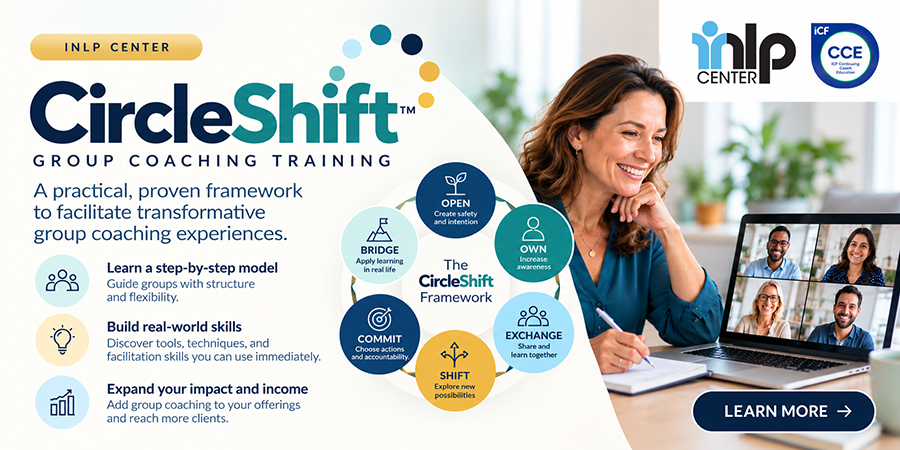
At iNLP Center, our CircleShift Group Coaching Training teaches a structured yet flexible approach to coaching groups. Students learn core concepts through self-paced lessons and build practical skills in live sessions focused on discussion, practicing the different stages, and group coaching practicums.
Frequently Asked Questions
Yes. Open-ended questions can be useful in online or in-person group coaching. What matters is how the coach supports participation and adapts to the group’s needs, not whether the conversation happens on a screen.
No. Different people may participate in different ways. A group coaching experience should respect participants’ comfort, choice, and the boundaries established for the group.
Icebreakers often help people become acquainted or comfortable interacting. Coaching questions are intended to support reflection, awareness, and personally meaningful learning. A good question alone does not determine whether an activity is coaching.
No. Questions are useful tools, but professional group coaching also requires skills in facilitation, coaching presence, group dynamics, ethics, and responsive decision-making.
Learn to Coach Groups With Confidence
If you’re interested in more than collecting good questions, the next step is learning how to facilitate a group coaching experience from beginning to end—while honoring the different goals of the people in it.
Explore CircleShift Group Coaching Training at iNLP Center to learn about our online curriculum, live practice sessions, and coaching practicums.

Co-founder and CEO of iNLP Center
Hope is an accomplished businesswoman and entrepreneur with a passion for empowering others to achieve their full potential.
With a Bachelor of Fine Arts (BFA) from California State University, Fullerton, and postgraduate education at Harvard Business School, Hope brings a unique blend of creativity, business acumen, and personal development expertise to her endeavors.
Hope’s entrepreneurial spirit shines through in her establishment of the iNLP Center, which has become a leading provider of NLP training and life coaching certification programs.