


Group coaching brings together people who may share a common interest but have very different experiences, goals, and perspectives. That diversity is one of its greatest strengths—and one of the reasons group coaching requires more than an agenda.
A well-structured group coaching session gives participants enough direction to feel supported while allowing room for the discoveries that make coaching valuable. The challenge is knowing how to guide a group without turning the experience into a lecture, a discussion free-for-all, or a series of individual coaching sessions conducted in front of an audience.
Let’s explore what effective group coaching session structure looks like and what makes it different from ordinary group facilitation.
Why Group Coaching Sessions Need Structure
Imagine bringing six people together to explore professional confidence. Some are comfortable speaking openly; others need time to reflect. One person wants practical action, while another is still figuring out what the challenge means to them.
Without a clear coaching approach, the most vocal participants may guide the discussion, the group may move too quickly toward advice, or people may leave without knowing what they gained.
Structure helps the coach create a shared experience that still respects individual needs. It provides a clear purpose, supports balanced participation, and helps people connect their insights to situations outside the group.
But structure should serve the people—not restrict them.
Understanding the Coaching Arc
Most meaningful coaching conversations have a natural rhythm. Participants arrive with a question or challenge, explore what matters, encounter new perspectives, and consider what their discoveries mean for their lives.
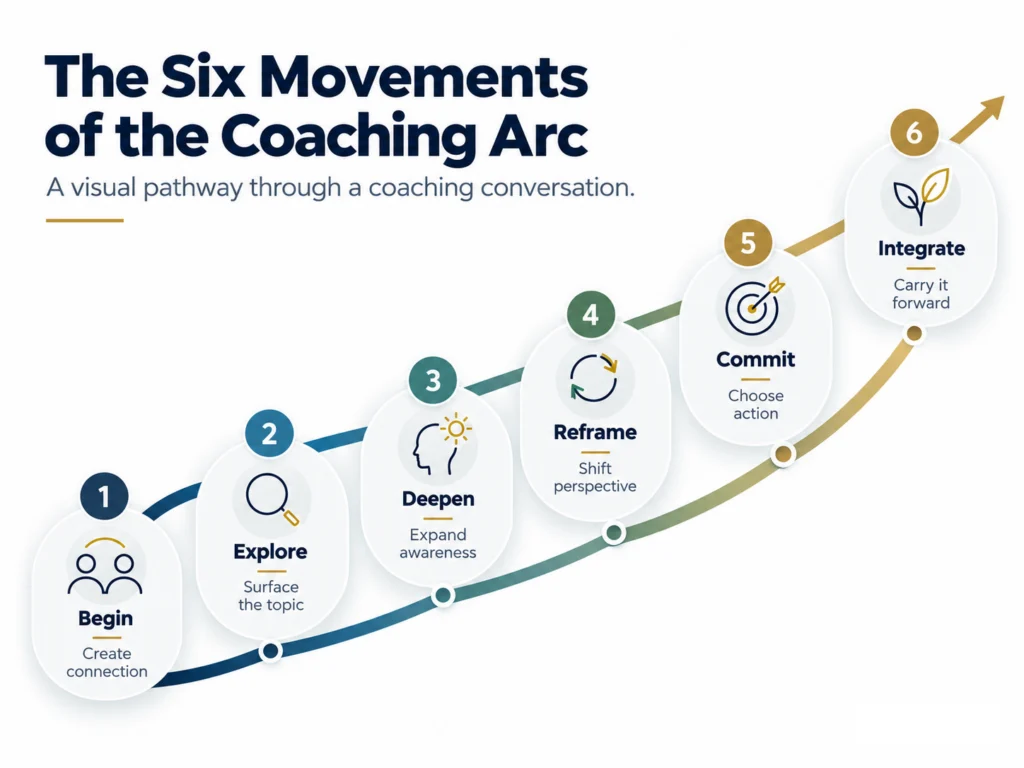
We refer to this broad progression as the Coaching Arc. It is a useful way to understand why a coaching conversation needs both direction and flexibility. The arc is not simply a list of questions or a schedule that every participant must follow at the same pace.
In one-to-one coaching, the coach can focus closely on one person’s experience. In a group, multiple people are learning at the same time, and their needs may shift as they hear from others. The coach must pay attention to the conversation as a whole without losing sight of individual growth.
That balance is at the heart of professional group coaching.
Four Qualities of an Effective Group Coaching Session
1. A Meaningful Shared Purpose
People benefit from knowing why they’ve gathered and what kind of experience they’re entering. A group may focus on leadership, confidence, career development, wellness, or another shared topic. But participants don’t have to define success in exactly the same way.
A clear purpose creates direction while leaving room for each person’s goals, circumstances, and choices.
2. Participation That Is Inclusive, Not Forced
Group coaching works best when participants have opportunities to contribute in ways that fit the situation and their comfort level. Meaningful participation might include speaking, listening, reflecting, or making connections to one’s own experience.
A skilled coach notices when some voices are dominating, when others are hesitant, and when the group needs more time to process. Facilitating inclusion is not the same as demanding that everyone share equally or reveal something personal.
3. Curiosity Instead of Advice-Giving
Group members naturally want to help one another. Their experiences can be a tremendous resource, but a coaching conversation can lose its focus when everyone begins offering solutions.
The coach’s responsibility is to keep the group oriented toward discovery. Participants should have the freedom to consider different perspectives without pressure to adopt someone else’s answer.
4. Learning That Matters Beyond the Conversation
A lively discussion can feel energizing in the moment. Effective coaching also helps people recognize why an insight matters and how it might influence decisions beyond the session.
Not everyone will leave with the same realization or commitment. That isn’t a weakness of group coaching; it’s often evidence that the group supported individual learning.
What Does This Look Like in a Real Group?
Consider an online group of professionals exploring how to become more confident at work. One participant struggles to contribute ideas in meetings. Another wants to handle difficult conversations more calmly. A third is trying to become comfortable setting boundaries.
Their experiences overlap, but they aren’t identical.
As the conversation unfolds, someone may recognize a familiar pattern in another participant’s story. Someone else may notice that a strategy that helped a peer would not fit their own situation. A quieter participant may reach a useful insight simply by listening.
The coach pays attention to these moments and the needs of the group, rather than forcing everyone toward a single conclusion. Participants benefit from the shared experience while retaining responsibility for their own decisions.
This is an important distinction between coaching a group and simply leading a group discussion.
Group Coaching vs. Teaching a Workshop
Workshops generally aim to deliver information or teach specific skills. The leader often has a planned set of concepts or activities participants are expected to learn.
Group coaching has a different emphasis. Participants bring their own experiences and goals, and the coach supports reflection, awareness, and personally meaningful progress. A group coaching program can include educational elements, but sharing content alone is not the same as coaching.
A coach may use an agenda or preparation materials. The difference is that the session remains responsive to the people in the room instead of becoming a presentation they simply attend.
For a deeper look at this distinction, explore our Group Coaching Facilitation Skills article.
What Influences the Design of a Group Coaching Session?
There is no single agenda that works for every group. Several factors affect how a coach prepares and facilitates, including:
- Group purpose: A leadership-development group has different needs from a personal-growth group.
- Group size and familiarity: People meeting for the first time may interact differently from a group with an established history.
- Delivery format: Online and in-person groups offer different opportunities and challenges for connection and participation.
- Participant needs: Different levels of experience, readiness, and comfort can affect the pace and style of the conversation.
- Professional boundaries: The coach needs to establish appropriate expectations and recognize when a concern falls outside the scope of coaching.
These considerations make thoughtful preparation essential, even when the coach intends to remain flexible during the session.
Common Group Coaching Mistakes to Avoid
Overplanning every moment. A tightly scripted session may leave little room for an unexpected but meaningful discovery.
Turning the group into an advice circle. Valuable peer experiences can become less useful when participants feel pressured to follow other people’s recommendations.
Assuming everyone wants the same outcome. A shared topic doesn’t mean every participant has the same personal goal.
Overlooking group dynamics. Dominant voices, silence, tension, and differing comfort levels all influence the experience.
Confusing coaching with therapy or training. Clear boundaries help protect participants and maintain the purpose of the group.
The goal is not to eliminate every challenge. It’s to become skillful enough to respond thoughtfully when these situations arise.
Learning to Facilitate With Confidence
Knowing that a session needs structure is only the beginning. Applying that understanding while people are speaking, reacting, reflecting, and learning together takes practice.
At iNLP Center, our CircleShift Group Coaching Training teaches a dedicated framework for facilitating meaningful group coaching experiences. The program brings together foundational coaching skills, group dynamics, and practical application through self-paced learning and live sessions devoted to discussion, practice, and coaching practicums.
Rather than relying on a fixed script, coaches learn to respond to the needs of a group while supporting the individual development of its members.
Frequently Asked Questions
An agenda can provide useful direction, but it shouldn’t prevent the coach from responding to what participants need. Effective group coaching balances preparation with flexibility.
Yes. Online group coaching can support meaningful interaction and reflection when the coach attends to participation, communication, and the experience of the group.
No. Workshops generally emphasize teaching or content delivery. Group coaching emphasizes the participants’ awareness, goals, and learning through a coached conversation.
Take the Next Step
You don’t have to choose between a rigid agenda and an unstructured discussion. Professional group coaching brings enough structure to guide the experience—and enough flexibility for participants to discover what matters most to them.
If you’re ready to develop those skills, explore CircleShift Group Coaching Training at iNLP Center, including the self-paced curriculum and live coaching practice opportunities.

Co-founder and CEO of iNLP Center
Hope is an accomplished businesswoman and entrepreneur with a passion for empowering others to achieve their full potential.
With a Bachelor of Fine Arts (BFA) from California State University, Fullerton, and postgraduate education at Harvard Business School, Hope brings a unique blend of creativity, business acumen, and personal development expertise to her endeavors.
Hope’s entrepreneurial spirit shines through in her establishment of the iNLP Center, which has become a leading provider of NLP training and life coaching certification programs.