

Imagine an executive who has recently been promoted to lead a large department. They have years of experience, strong technical expertise, and a clear understanding of organizational goals. Yet they struggle to delegate, become defensive when challenged, and feel personally responsible for every decision their team makes.
A conventional leadership development approach might focus on delegation techniques, communication strategies, or decision-making frameworks. Those skills may be useful, but they don’t necessarily address why this executive finds it so difficult to put them into practice.
Perhaps their professional identity has always been built around being the person with the answers. Perhaps they believe that making mistakes will damage their credibility. Or maybe their personal need for certainty makes trusting others particularly uncomfortable.
These are not simply leadership skill gaps. They involve the beliefs, values, emotions, and internal patterns of the person doing the leading.
This is why effective executive coaching must address the whole person, not just their leadership performance.
Holistic executive coaching recognizes that professional behavior cannot be completely separated from personal identity, experiences, and ways of thinking. It helps leaders develop greater awareness of themselves while considering how their choices affect their teams and organizations.

The Person Behind the Leadership Role
Executives don’t leave their personal beliefs, emotional patterns, or life experiences at the office door. They bring these influences into every meeting, decision, difficult conversation, and leadership relationship.
Consider two executives facing the same challenge: an employee who repeatedly misses deadlines.
One executive may approach the situation with curiosity, seeking to understand what’s happening and how to support improvement. Another may respond with frustration, interpreting the missed deadlines as evidence of disrespect or incompetence.
The external situation is similar, but their responses are very different.
Why?
Each leader is interpreting the situation through an individual set of beliefs, expectations, experiences, and emotional associations. Those interpretations influence behavior, often without conscious awareness.
An executive who values reliability above almost everything else might interpret a missed commitment as a personal betrayal. Someone who grew up believing mistakes were unacceptable might respond to errors with excessive control. A leader who associates disagreement with rejection may avoid necessary conflict or become defensive when challenged.
These patterns do not automatically indicate a psychological problem. They are examples of how personal meaning influences professional behavior.
Whole-person executive coaching helps leaders examine these connections, recognize where familiar patterns serve them, and explore where different choices might produce better outcomes.
Why Leadership Skills Alone Don’t Always Produce Change
Leadership training provides important information. Executives can learn effective delegation, conflict resolution, strategic thinking, and communication techniques.
But knowing what to do and consistently doing it are two different things.
A leader might understand that empowering employees increases ownership, yet continue to micromanage. Another might know how to deliver constructive feedback but postpone difficult conversations for weeks.
In these situations, additional instruction may not be the missing ingredient.
The leader may need to explore the beliefs and assumptions influencing their behavior.
For example, an executive who consistently takes on too much work might discover a deeply held belief that being valuable means being indispensable. Delegation then feels less like a practical management decision and more like a threat to their identity.
Until that association is recognized, the leader may resist even the most effective productivity system.
An executive coach can help the client explore questions such as:
- What does being a successful leader mean to you personally?
- What are you concerned might happen if you approach this differently?
- Which assumptions are influencing your decisions?
- How does this pattern support you, and where might it limit you?
- What would leadership look like if you no longer needed to prove your value in the same way?
These questions move beyond improving an isolated behavior. They help the executive explore the thinking that produces it.
What Research Tells Us About Whole-Person Executive Coaching
The relationship between personal development and professional effectiveness has been recognized in executive coaching research for decades.
In their paper Executive Coaching in Organisations: The Personal Is the Professional, researchers Michael Cavanagh and Anthony Grant argued that effective executive coaching must consider the overlap between a leader’s personal and professional experiences.
Their work emphasizes the importance of understanding how beliefs, emotions, values, and patterns of thinking influence professional behavior.
More recent evidence also supports the potential for executive coaching to influence more than workplace skills.
A 2023 meta-analysis published in Frontiers in Psychology reviewed 20 controlled studies examining executive coaching outcomes. The researchers found positive effects on several dimensions, including behavioral outcomes, self-efficacy, psychological capital, and resilience.
Behavioral outcomes showed particularly strong effects, suggesting that coaching can help clients translate new awareness into meaningful changes in how they act.
The research doesn’t establish that every coaching method produces the same results. It does, however, provide evidence that executive coaching can support development across multiple dimensions of the individual.
This broader perspective is also reflected in the International Coaching Federation’s 2025 Core Competencies, which emphasize understanding clients within the context of their identity, experiences, environment, values, beliefs, and relationships.
In other words, coaching the whole person is not a departure from professional coaching principles. It is closely aligned with them.
The Connection Between Personal Awareness and Organizational Impact
Whole-person coaching is especially important in executive settings because a leader’s personal patterns can influence far more than their own performance.
Imagine a senior director who avoids disagreement because maintaining harmony is personally important.
At the individual level, this might appear as reluctance to give direct feedback. At the team level, employees may become confused about expectations or hesitate to raise concerns. At the organizational level, unresolved problems could affect productivity, decision-making, and accountability.
The executive’s personal pattern has consequences throughout the system.
The reverse can also occur.
An organization that rewards constant availability may reinforce a leader’s belief that they must handle everything personally. A highly competitive workplace culture may make collaboration feel risky, even when the executive genuinely values teamwork.
This means effective executive coaching must examine both directions of influence: how the individual affects the organization and how the organizational environment influences the individual.
Focusing only on the leader’s personal development misses important external conditions. Focusing only on organizational performance overlooks the human being making the decisions.
The most useful coaching perspective connects both.
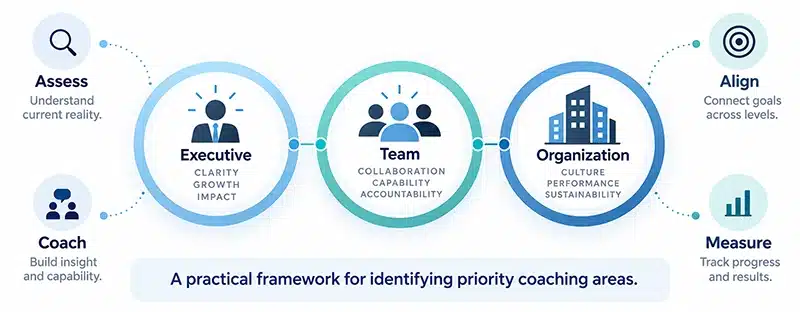
The GAPS Model: Coaching the Executive, the Team, and the Organization
At iNLP Center, this interconnected approach is a central part of our Executive Coaching and Leadership Certification Training.
Our GAPS model—Generated Areas for Purposeful Strategy— helps executive coaches explore leadership challenges through three interconnected perspectives: the executive, the team, and the organization.
The Executive
This perspective considers the individual leader’s values, beliefs, communication patterns, strengths, assumptions, motivations, and professional goals. It invites reflection on the person behind the leadership role and the internal resources available for growth.
The Team
This perspective explores how the executive’s behavior influences relationships, communication, collaboration, trust, and performance. It also considers how team dynamics shape the leader’s experience and choices.
The Organization
This perspective examines the broader business environment, including culture, strategic objectives, expectations, resources, systems, and measures of success.
The value of GAPS is not simply identifying three categories. It’s recognizing their relationships and discovering where meaningful change can occur.
Consider an executive who says, “I need my team to take more initiative.”
At the executive level, coaching might reveal an underlying need to maintain control. At the team level, employees may have learned that independent decisions are frequently questioned or overturned. At the organizational level, unclear approval policies may reinforce this dependence.
What first appeared to be a motivation problem may actually involve leadership identity, team expectations, and organizational processes.
A whole-person, systems-aware coaching approach helps the executive recognize these influences without assuming that the leader alone is responsible for every problem.
From there, the client can develop a more comprehensive strategy for change.
How NLP-Integrated Coaching Supports Deeper Awareness
Neuro-Linguistic Programming (NLP) offers several frameworks that can be used to structure reflection on the relationship between thinking, communication, and behavior.
In executive coaching, these frameworks can support questions about how a leader interprets situations, responds to others, and develops strategies for achieving goals.
For example, perceptual positions invite a client to consider an experience from different viewpoints. An executive preparing for a difficult conversation might explore their own perspective, imagine how the other person may be experiencing the situation, and consider what a more detached observer might notice.
This doesn’t mean the executive can know exactly what someone else is thinking. Rather, the process encourages curiosity and creates opportunities to challenge assumptions.
The NLP Logical Levels framework provides another way to organize reflection. An executive might examine the connection between their environment, behavior, capabilities, beliefs, values, and sense of identity.
A recurring challenge with delegation, for instance, may be discussed at the behavioral level—what the executive is doing—and at the level of beliefs or identity—what delegating means to them.
These models are best understood as structured inquiry tools rather than diagnostic assessments or scientifically established explanations of human behavior. Their usefulness in coaching depends on how thoughtfully they are applied and whether they help the client generate meaningful insight.
Combined with ICF-aligned coaching competencies, they can help coaches move beyond surface-level problem-solving while maintaining the client’s autonomy.
A Practical Example: From Personal Insight to Leadership Change
Consider a fictional example of a vice president who has recently taken responsibility for three departments.
She describes herself as overwhelmed. Her calendar is filled with operational meetings, her directors regularly seek approval for routine decisions, and she has little time for strategic planning.
Her initial coaching goal is straightforward: “I need to manage my time better.”
A coach could immediately introduce time-management techniques. But a whole-person approach explores what is sustaining the problem.
During coaching, the executive begins to recognize that she feels uncomfortable when important decisions are made without her involvement.
She connects this discomfort to a longstanding professional identity: she has always been recognized for solving difficult problems and knowing the answers.
As her responsibilities increased, the same qualities that supported her earlier success began limiting her effectiveness in a larger leadership role.
The coaching conversation shifts from scheduling to a more meaningful question: What does she believe her contribution should be now?
She realizes that her value no longer comes primarily from personally solving every problem. It increasingly comes from developing capable leaders who can solve problems independently.
That insight creates an opportunity for behavioral change.
She decides to experiment with a different approach during meetings. Rather than immediately offering solutions, she asks her directors what options they have considered and what decision they recommend.
The executive can then evaluate whether this change affects the quality of decisions, her directors’ independence, and the time available for strategic responsibilities.
Notice what happened.
The coaching began with a practical leadership concern, explored a personal belief connected to the executive’s identity, and returned to observable professional behavior.
The personal insight became valuable because it informed a different leadership choice.
Whole-Person Coaching Still Requires Professional Boundaries
Exploring personal beliefs, values, and emotions does not mean executive coaching should become psychotherapy.
Professional coaching can help clients examine how their thoughts, experiences, and emotional responses influence their choices. However, diagnosis and treatment of mental health conditions belong to appropriately qualified healthcare professionals.
The coach’s responsibility is to maintain clear agreements, respect the client’s autonomy, work within their competence, and recognize when a referral may be appropriate.
This is particularly important when an organization is paying for the coaching.
An employer may want measurable improvements in leadership effectiveness, but the executive must still have an appropriate level of confidentiality and choice regarding personal disclosure.
The coach can partner with the executive and organizational sponsor to establish professional goals and meaningful measures of progress without unnecessarily revealing private coaching conversations.
Whole-person coaching should deepen the quality of the coaching partnership, not blur its ethical boundaries.
What Does Success Look Like in Whole-Person Executive Coaching?
Success is not measured solely by whether the executive feels more self-aware.
Self-awareness becomes especially meaningful when it supports choices and behaviors that align with the client’s goals.
An executive who recognizes a pattern of defensiveness might begin inviting alternative perspectives more consistently. A leader who associates responsibility with personal control might gradually develop more effective delegation practices. Someone who discovers that a personal value conflicts with their organizational role may clarify what needs to change.
Depending on the engagement, progress might be reflected in more effective conversations, clearer responsibilities, better decisions, stronger working relationships, increased confidence, or improved alignment between individual and organizational objectives.
These outcomes should be defined collaboratively, not imposed by the coach.
A useful question is whether the executive’s new awareness is translating into changes that matter to them and to the people affected by their leadership.
That is where personal development and organizational effectiveness intersect.
Why Whole-Person Executive Coaching Matters for Coaches
For coaches interested in specializing in executive development, this approach requires more than familiarity with leadership theories.
It calls for the ability to listen beyond the presenting problem, notice patterns without making assumptions, explore beliefs without becoming prescriptive, and understand organizational dynamics without taking responsibility for the client’s decisions.
It also requires comfort with complexity.
An executive may be highly successful while struggling with self-doubt. They may value collaboration yet behave competitively under pressure. They may genuinely want to empower their team while unintentionally reinforcing dependence.
The executive coach’s role is not to label these contradictions or rush to eliminate them. It is to help clients become aware of what is happening, consider new possibilities, and make intentional choices.
Coaches who can connect personal insight with practical leadership development bring a broader perspective to their work.
Becoming an Executive Coach Who Sees the Whole Picture
Executive coaching is most powerful when it recognizes that leaders are people first.
Their personal values influence their professional priorities. Their beliefs shape how they interpret challenges. Their emotions affect conversations and decisions. Their identity influences what they believe they must do to be successful.
And all of these interact with the teams and organizations they lead.
A whole-person approach doesn’t disregard leadership skills or business results. It provides a deeper understanding of the human factors that influence both.
At iNLP Center, our 30-hour Executive Coaching and Leadership Certification Training prepares coaches to work with these interconnected dimensions through professional coaching competencies, NLP-integrated approaches, the GAPS model, and practical executive coaching applications.
The program explores high-level communication, leadership and motivation, organizational culture, personal and professional values, goal achievement, and methods for evaluating meaningful progress.
If you’re interested in supporting leaders beyond surface-level performance improvement, developing this broader coaching perspective can be an important next step.
Explore iNLP Center’s Executive Coaching & Leadership Certification Training
For a broader introduction to the profession, see What Is an Executive Coach?. To explore how technology is reshaping the profession, read Executive Coaching Trends in 2026.

Jean O’Toole, PCC, is an Executive Coach and Entrepreneur Strategist.
She has coached thousands of 1:1 sessions with high-performing clients throughout the world. She is a driven business builder, and her multiple businesses have helped thousands of individuals in their education and wellness goals. Jean is an award-winning speaker and best-selling author. Over 150,000 people have attended her presentations designed to empower individuals to take action in their lives. She has been featured in U.S. News and World Report, Fox Business, College Confidential, and CollegeXpress, and has been a guest on numerous podcasts and radio shows throughout the world. She has proudly served as an assistant faculty member at the Kripalu Center for Yoga and Health for multiple workshops and training. Jean is dedicated to helping others ignite their passion for creativity and connection through expressive arts and knows firsthand that honoring the whole self resonates in all areas of life.