
- Life Coach Requirements: What You Need to Become an ICF-Credentialed Coach
- Are There Legal Requirements to Become a Life Coach?
- Step 1: Complete Professional Coach Training
- Step 2: Gain Real Coaching Experience
- Step 3: Complete Mentor Coaching
- Step 4: Demonstrate Your Coaching Skills
- Step 5: Pass the ICF Credentialing Exam
- How to Choose the Right Training Program
- Beyond the Credential
Life Coach Requirements: What You Need to Become an ICF-Credentialed Coach
If you’ve been researching life coach requirements, you’ve probably discovered something surprising: anyone can technically call themselves a life coach.
Unlike professions such as psychology or counseling, life coaching is not government regulated in most countries. However, that doesn’t mean all coaches have the same level of education, ethics, or professional competence.
For individuals who want to build a credible coaching career, the International Coaching Federation (ICF) has become the global gold standard. An ICF credential demonstrates that a coach has completed professional education, accumulated real coaching experience, developed coaching skills under supervision, and demonstrated competence through assessment. (ICF)
If you’re wondering what the actual life coach requirements are to become an ICF-certified coach, here’s everything you need to know.
Are There Legal Requirements to Become a Life Coach?
One of the biggest misconceptions is that you must have a license to become a life coach. In reality, there are generally no legal licensing requirements for life coaching in most regions. This means anyone can start offering coaching services.
However, professional coaching is built on trust. Clients increasingly look for coaches who have completed recognized training and follow ethical standards. That’s why many successful coaches choose to earn an ICF credential.
An ICF credential signals that you have been trained in evidence-based coaching practices rather than simply offering advice or mentoring. Coaching creates meaningful change in people’s lives and clients deserve coaches who know how to maintain professional boundaries, ask empowering questions, avoid giving inappropriate advice, respect client autonomy, create a safe coaching relationship, and coach ethically and effectively.
The ICF requirements help ensure coaches possess these essential competencies before earning a professional credential.

Quality coach education typically includes:
• Coaching communication skills
• Active listening
• Powerful questioning
• Goal setting and accountability
• Ethics & professional standards
• Practice coaching with feedback
• The ICF Core Competencies
Step 1: Complete Professional Coach Training
The first major life coach requirement is completing coach-specific education.
To qualify for the ICF Associate Certified Coach (ACC) credential, you must complete at least 60 hours of coach-specific education. These hours must focus on coaching skills, ethical practice, and the ICF Core Competencies rather than general personal development or motivational speaking. (ICF)
Many aspiring coaches choose an ICF-accredited training program because it simplifies the credentialing process. Others may combine accredited and non-accredited education if they meet the Portfolio application requirements.
Professional training provides the foundation you’ll use throughout your coaching career.
Step 2: Gain Real Coaching Experience
Learning coaching concepts isn’t enough.
The ICF requires aspiring coaches to demonstrate that they can effectively coach real clients.
This experience requirement ensures coaches can apply coaching skills consistently across different client situations.
Many coaches begin by coaching friends, colleagues, or volunteer clients before transitioning into paid coaching. As they gain confidence and experience, they gradually build a sustainable coaching practice.
To apply for the ACC credential, coaches must have completed:
• 100 coaching hours
– At least 75 paid coaching hours
– At least 25 completed 18 months
prior to ICF application
– With at least 8 different clients/volunteers
Step 3: Complete Mentor Coaching

To qualify for the ACC credential, you must complete:
• 10 hours of ICF mentor coaching
– Spread over at least three months
– Including a minimum of 3 hours of 1-1 mentor coaching
One of the unique life coach requirements established by the ICF is mentor coaching.
Mentor coaching is different from coach training. Instead of learning coaching concepts, you receive individualized feedback on your actual coaching sessions from an experienced credentialed coach.
This process helps coaches refine their skills, eliminate ineffective habits, and consistently coach according to ICF standards.
Many experienced coaches describe mentor coaching as one of the most valuable parts of their professional development.
Mentor is included in Level 1 and Level 2 coach trainings.
Step 4: Demonstrate Your Coaching Skills
Professional coaching isn’t measured by written assignments alone. The ICF also requires candidates to successfully complete a performance evaluation that demonstrates they can coach according to the ICF Core Competencies.
Depending on the application path, the performance evaluation may be either built into an accredited training program (a Level 1 or 2 training) or require submission of a recorded coaching session and transcript. However, beginning January 2027, performance evaluations will not be part of the application process.
The evaluation focuses on coaching behaviors such as:
• Establishing trust and partnership
• Listening deeply
• Maintaining coaching presence
• Asking thought-provoking questions
• Supporting client awareness
• Facilitating client growth
Step 5: Pass the ICF Credentialing Exam
The exam assesses your understanding of:
• The ICF Core Competencies
• The ICF Code of Ethics
• Professional coaching standards
• Appropriate coaching boundaries
• Coaching knowledge and best practices

The final major life coach requirement is passing the ICF ACC Exam. the ICF exam is designed to assess how well you can apply coaching principles in realistic coaching situations. Candidates are presented with scenarios that require them to identify the best response. The exam evaluates your professional judgment, ethical decision-making, coaching mindset, and ability to distinguish true coaching from advising, consulting, mentoring, or directing a client.
Preparing thoroughly for the exam helps ensure you’re ready to coach ethically and professionally.
How to Choose the Right Training Program
Not all coach training programs are created equal. When evaluating programs, check they meet these requirements:
- The program is an ICF Level 1 and/or Level 2 Training (really important!)
- All 100 coaching practice hours for the ACC are included (really important!)
- You’ll receive constructive feedback from experienced faculty
- 10 hours of Mentor coaching
- Support with credentialing requirements
- Preparation for the ICF credentialing exam
- Marketing and business building (optional but really important!)

Meeting the ICF’s credentialing requirements is an important milestone—but not all coach training programs provide the same learning experience.
Many coach training schools are intentionally designed to help students satisfy the minimum requirements needed to apply for an ICF credential. They provide the required education hours, mentor coaching, performance evaluation, and exam preparation necessary for certification. However, while meeting those standards is essential, some coaches want a program that prepares them not only to earn a credential, but also to become exceptional coaches who are confident working with a wide range of clients.
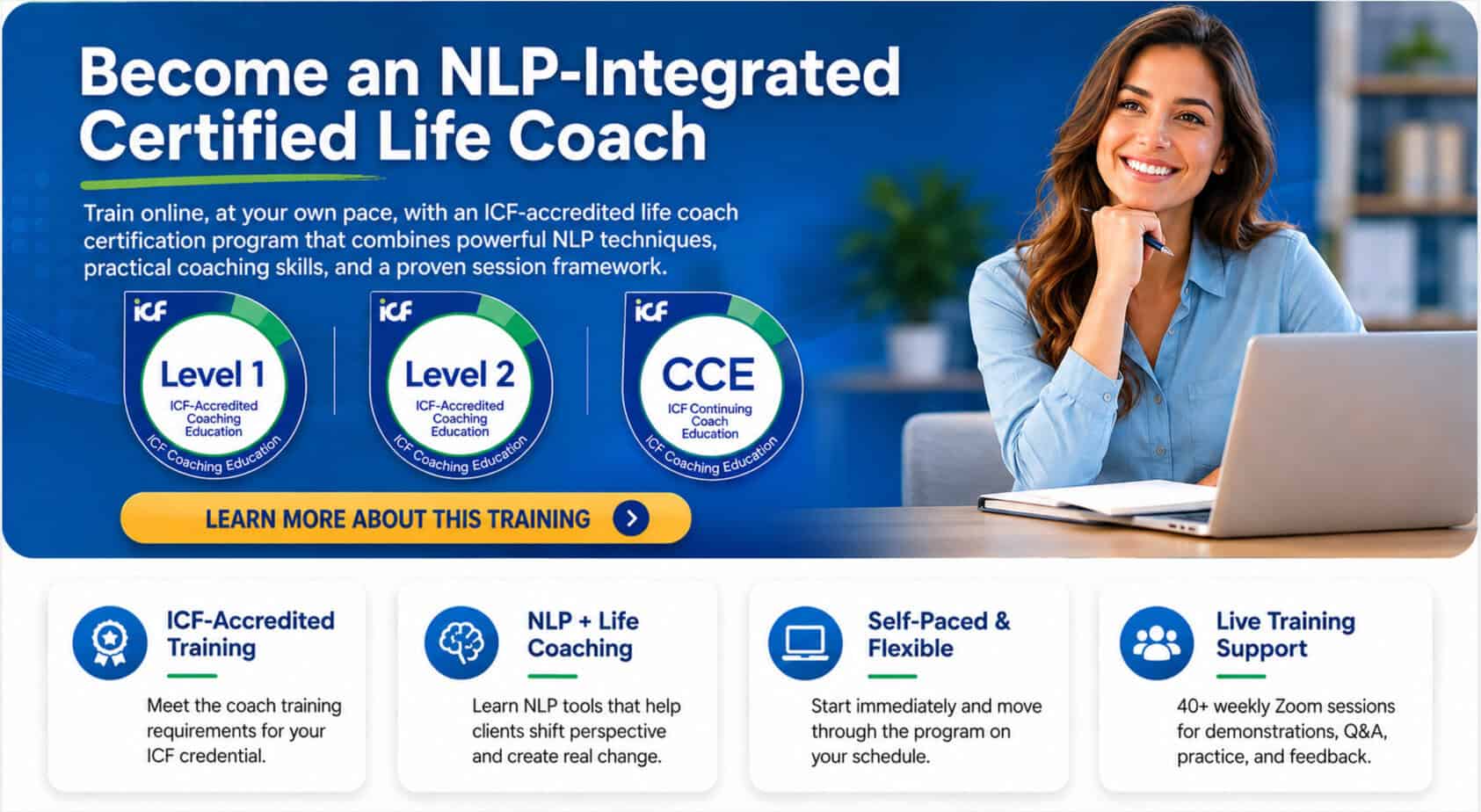
That’s where INLP Center’s NLP-Integrated Life Coach Training takes a different approach. Rather than simply checking the boxes required by the ICF, INLP Center has designed its training to develop highly skilled, adaptable coaches through a much deeper educational experience.
In addition to meeting ICF education standards, INLP Center emphasizes:
✓ A More Comprehensive Coaching Psychology Foundation
Students learn not only what to ask, but why people think, feel, and behave the way they do. The curriculum draws from coaching psychology, neuroscience, communication, emotional intelligence, behavior change, and adult learning to help coaches understand lasting transformation.
✓ Extensive Practice and Feedback
Great coaching isn’t developed by watching videos alone. INLP Center incorporates significant opportunities for live practice, instructor feedback, peer coaching, demonstrations, and skill refinement so students build confidence before working with clients independently.
✓ Multiple Coaching Modalities
Rather than teaching a single coaching framework, students are exposed to a variety of evidence-informed coaching approaches. This allows graduates to adapt their coaching style to different personalities, goals, and client situations while remaining aligned with the ICF Core Competencies.
✓ Personal Development Alongside Professional Development
One of the distinguishing features of INLP Center’s programs is that students experience coaching from both sides of the conversation. As they develop coaching skills, they also deepen their own self-awareness, emotional intelligence, communication abilities, and leadership capacity. This personal growth often becomes one of the most valuable aspects of the training.
✓ Business and Professional Readiness
Learning to coach is only one part of becoming a successful professional coach. INLP Center also helps students understand how to build credibility, attract clients, communicate their value, and create a sustainable coaching practice—skills that are often beyond the minimum requirements for certification.
✓ Unlimited Coach Practice Hours
You’ll have the ability to earn ALL your coaching practice hours needed for your ACC and future credential for as long as you need. These are incorporated into your training program so you’ll be ready to apply for your ACC credential upon graduation.
✓ Lifelong Learning
ICF credentials are the beginning of a coaching career—not the finish line. INLP Center encourages ongoing professional development through FREE lifetime training access and support, advanced certifications in specialized areas, ICF continuing education, and a vibrant learning community that supports coaches long after graduation.
Beyond the Credential
An ICF credential demonstrates that you’ve met internationally recognized standards for professional coaching. That’s an important achievement and one that can open doors throughout your coaching career.
But becoming an outstanding coach requires more than meeting minimum requirements. It requires continual practice, meaningful feedback, personal growth, and a commitment to mastering the art and science of coaching.
If your goal is simply to qualify for an ICF credential, many programs can help you get there. If your goal is to become a highly skilled, confident, and transformational coach who is equipped to make a lasting impact, choosing a program that goes beyond the minimum standards can make all the difference.
At INLP Center, the philosophy is simple: certification is the starting point—excellence is the destination.

Co-founder and CEO of iNLP Center
Hope is an accomplished businesswoman and entrepreneur with a passion for empowering others to achieve their full potential.
With a Bachelor of Fine Arts (BFA) from California State University, Fullerton, and postgraduate education at Harvard Business School, Hope brings a unique blend of creativity, business acumen, and personal development expertise to her endeavors.
Hope’s entrepreneurial spirit shines through in her establishment of the iNLP Center, which has become a leading provider of NLP training and life coaching certification programs.