


Executive coaching is often considered one of the higher-paying specialties in professional coaching. Experienced executive coaches may charge several hundred dollars per session, and some establish long-term engagements with organizations that invest substantially in leadership development.
But how much do executive coaches actually earn? And what separates a coach charging $150 per session from one charging $350, $500, or more?
The answer involves more than choosing a profitable coaching niche. Executive coaching income depends on professional experience, the clients served, the value of the engagement, the coach’s reputation, and the ability to develop a sustainable practice.
Research from the International Coaching Federation (ICF) provides useful insight into these questions. Its studies show that executive-focused coaching can command higher fees than many other coaching specialties, while also highlighting how widely earnings vary throughout the profession.
For coaches considering an executive coaching specialization, understanding these numbers is an important starting point.
How Much Do Executive Coaches Make?
According to the 2023 ICF Global Coaching Study, coaches specializing in executive coaching reported average annual coaching revenue of $79,300, with an average one-hour session fee of $340.
Coaches whose clients were primarily executives—including CEOs, CFOs, and other senior leaders—reported even higher figures: $87,700 in average annual coaching revenue and $360 per one-hour session.
These are two different groups. The first is based on the coach’s primary specialty; the second is based on the type of client the coach primarily serves.
The distinction matters because it suggests that both specialization and clientele are associated with coaching revenue.
What the ICF Research Shows
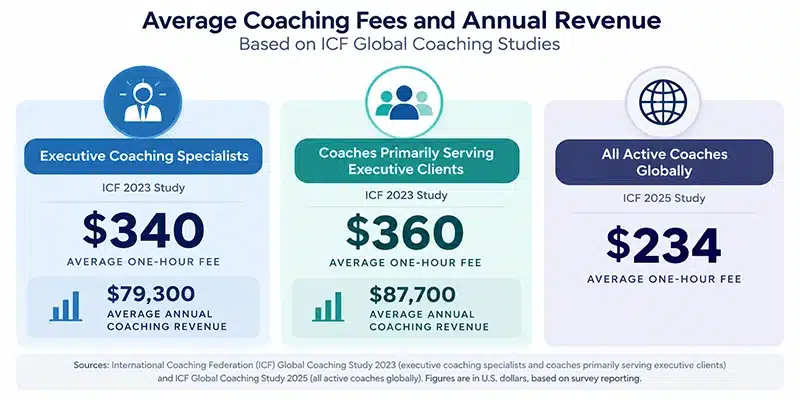
Sources: ICF Global Coaching Studies, 2023 and 2025. Figures are in U.S. dollars, based on survey reporting. The 2025 figures represent the entire coaching profession, not executive coaches specifically. The different study years and populations should not be interpreted as a precise measurement of an executive coaching premium.
The 2025 ICF Global Coaching Study estimated that the coaching profession generated $5.34 billion in annual global revenue, with approximately 123,000 coach practitioners worldwide.
The study also reported that 59% of coaches expected their annual revenue to increase, primarily through serving more clients and conducting more coaching sessions rather than simply raising their prices.
These findings suggest a substantial and developing professional coaching market. They do not guarantee that individual coaches will achieve the reported averages, but they provide useful benchmarks for evaluating the opportunities available.
Can Executive Coaches Really Charge $350–$500 per Session?
Yes. Coaching fees in that range are possible, particularly for established executive coaches working with corporate clients.
ICF’s reported averages of $340 and $360 per session demonstrate that fees in the mid-$300 range were already being achieved across executive-focused coaching practices in its 2023 research.
Higher rates are not new to the profession.
In a Harvard Business Review survey published in 2009, 140 experienced executive coaches reported a median hourly coaching fee of $500. The range was substantial, with some coaches charging considerably more.
That historical survey is not a current market average, and its participants were established coaches rather than a representative sample of all practitioners. Still, it demonstrates that organizations have long been willing to make significant investments in executive coaching.
The important question for aspiring executive coaches is not simply whether they can eventually charge $500 per session. It’s what professional capabilities, experience, positioning, and client relationships would support that fee.
A coach serving an individual manager who personally pays for sessions may encounter a different pricing environment from a coach engaged by an organization to support a senior executive through a complex leadership transition.
The nature and value of the engagement often influence what a client is willing to invest.
Why Do Executive Coaches Often Earn More?
Executive coaching addresses challenges that can have consequences across entire teams and organizations.
A senior leader’s ability to communicate effectively, make strategic decisions, develop employees, manage change, and resolve conflict influences far more than their individual performance.
Consider a director who has difficulty delegating responsibility. The problem may be affecting their productivity, but it may also be limiting the development of other leaders, slowing organizational decisions, and creating frustration among employees.
A coaching engagement that helps the executive recognize the factors contributing to this pattern and develop different leadership behaviors can potentially influence multiple organizational outcomes.
This doesn’t mean the coach can claim credit for every improvement or guarantee a financial return. Organizational outcomes are influenced by many factors.
It does, however, explain why businesses may see executive coaching as an investment in leadership capability rather than simply the purchase of an hour-long conversation.
Executive coaching fees often reflect the complexity and organizational significance of the work, not just the time spent in the session.
This is also why professional agreements, clearly defined goals, and meaningful ways to evaluate progress are particularly important in executive coaching engagements.
What Influences an Executive Coach’s Earning Potential?
Although the executive coaching specialty is associated with relatively high fees, not every executive coach earns the same amount.
Several factors influence what coaches charge and how much revenue they generate.
Experience and Professional Credibility
Coaches with established experience may be better positioned to work with senior leaders who face complex interpersonal and organizational challenges.
Executive clients and sponsoring organizations often want confidence that the coach can navigate sensitive conversations, maintain professional boundaries, and create an effective developmental partnership.
Experience in coaching, leadership, human resources, organizational development, or related fields may contribute to credibility, depending on the clients being served.
Professional training and ICF credentials can also help demonstrate commitment to recognized coaching competencies and ethical standards. However, a certification or credential does not automatically create demand or justify a particular fee.
The Level of Clients Served
The ICF research indicates that client seniority is associated with differences in coaching fees.
A coach working primarily with senior executives may charge more than one working with individual contributors or first-time managers.
This doesn’t make coaching at one organizational level inherently more valuable than another. Rather, the scope of responsibility, business context, budget, and expectations of the engagement may differ.
For example, coaching a new manager through basic delegation challenges might involve a different level of organizational complexity from coaching a CEO through succession planning, major restructuring, or company-wide change.
Corporate-Sponsored Coaching
Who pays for coaching also matters.
ICF’s 2023 research found that coaches with a larger proportion of sponsored clients tended to report higher session fees and annual coaching revenue.
A sponsored engagement occurs when an organization or another party pays for an individual’s coaching.
Corporate-sponsored executive coaching may involve agreements among the coach, executive, and sponsoring organization. These agreements establish objectives, confidentiality, responsibilities, and the process for evaluating progress.
Working successfully within this three-part relationship requires an understanding of both coaching ethics and organizational dynamics.
Specialization and Demonstrated Value
Executive coaching is a specialty in its own right, but coaches may also develop expertise in particular leadership challenges or client populations.
Examples include supporting newly promoted executives, leadership transitions, organizational change, executive communication, or team effectiveness.
Specialization can help potential clients understand the type of support a coach provides. It may also help coaches build relevant experience, develop referrals, and distinguish their services in a competitive market.
However, positioning alone is not enough. A coach must be prepared to deliver the professional service being offered.
Hourly Coaching Fees Are Not the Same as Annual Income
One of the most important distinctions when evaluating executive coaching income is the difference between a session fee and actual earnings.
A coach who charges $400 for a session does not necessarily earn $400 for every hour worked.
In addition to client conversations, professional coaches spend time on preparation, discovery meetings, business development, administration, continuing education, supervision, and other activities.
Not all of that time generates direct revenue.
Consider three hypothetical coaching practices, each delivering 46 weeks of paid sessions per year.
| Coaching sessions per week | Fee per session | Illustrative annual revenue |
|---|---|---|
| 4 | $250 | $46,000 |
| 6 | $350 | $96,600 |
| 8 | $500 | $184,000 |
These examples illustrate the mathematical possibilities of different rates and client volumes. They are not ICF income averages or forecasts for new executive coaches.
Actual revenue will depend on booked and completed sessions, client retention, pricing arrangements, cancellations, and the time required to build and maintain a practice.
Expenses such as marketing, professional development, technology, business insurance, and taxes further affect take-home income.
A coach charging a premium rate may have fewer clients than someone charging less. Conversely, a coach with consistent long-term organizational relationships may generate steady revenue without delivering a large number of individual sessions each week.
The sustainability of an executive coaching practice depends as much on consistent client relationships and effective business management as it does on session pricing.
Executive Coach Salary vs. Independent Coaching Revenue
People searching for “executive coach salary” are often looking for one of two different answers.
The first concerns compensation for an employed professional working as an internal executive coach, leadership development coach, or organizational development specialist.
The second concerns revenue earned by an independent coach who contracts directly with executives, businesses, or organizations.
These are different business arrangements.
An internal coach generally receives compensation through an employer, potentially including benefits and other employment-related compensation.
An independent executive coach typically establishes their own pricing, manages business expenses, develops client relationships, and assumes responsibility for generating new work.
ICF’s coaching studies primarily report coaching fees and revenue from coaching activities. Those figures should not be treated as equivalent to standardized employee salary data.
Someone considering a career in executive coaching should therefore evaluate the opportunities within their intended employment or business model.
Why Executive Coaching May Become Even More Valuable in the Age of AI
The professional opportunity in executive coaching is not limited to income.
The demands placed on leaders are changing as artificial intelligence reshapes how organizations gather information, automate work, and make decisions.
AI can support data analysis, operational planning, and many administrative activities. But leaders remain responsible for navigating the human consequences of change.
They must communicate decisions, maintain trust, evaluate competing priorities, address uncertainty, and help employees adapt.
Executive coaching provides a professional partnership in which leaders can examine how they are responding to these demands, consider different perspectives, and make more intentional decisions.
For example, a senior manager implementing AI-assisted processes may be focused on improved efficiency while overlooking employee concerns about changing roles and expectations.
An executive coach might help that leader explore the relationship between their business objectives, communication choices, and team experience.
This is an opportunity for coaching that addresses the whole person while recognizing the broader organizational context.
For a deeper discussion of these developments, see our article on Executive Coaching Trends in 2026.
Although growing technological complexity may create additional reasons for organizations to seek coaching, future demand and income levels cannot be guaranteed.
What Skills Help Executive Coaches Build a Valuable Practice?
Developing an executive coaching specialty requires more than understanding business terminology or having previous leadership experience.
Executive coaches need the professional competencies to establish trust, listen deeply, ask meaningful questions, support client awareness, and facilitate client-owned action.
They also benefit from understanding how executive behavior interacts with organizational culture, team dynamics, expectations, strategic priorities, and performance.
For example, imagine an executive who wants to improve their team’s accountability.
A narrowly focused approach might explore time-management systems and reporting procedures.
A more comprehensive executive coaching process could also examine the leader’s beliefs about delegation, the team’s understanding of responsibilities, and the organization’s expectations.
The challenge involves the executive, the team, and the organization.
At iNLP Center, our GAPS framework—Goal Areas for Purposeful Strategy— helps coaches assess these interconnected areas and identify priorities for coaching.
The framework is integrated into our Executive Coaching & Leadership Certification Training, along with NLP-informed coaching tools, organizational communication, leadership and motivation, goal setting, personal values, and strategies for evaluating progress.
This broader approach equips coaches to support clients in exploring both personal leadership patterns and their effects within the workplace.
You can read more about this perspective in our article Executive Coaching Is About the Whole Person, Not Just Leadership Skills.
How to Begin Building an Executive Coaching Practice
For an existing professional coach, executive coaching can provide an opportunity to expand into organizational and leadership-focused work.
For someone entering the coaching profession, it may represent a longer-term specialization that develops alongside foundational coaching competencies and practical experience.
Building a practice involves several connected decisions.
The first is identifying the leaders or organizations you want to serve. A coach who understands the challenges of their intended clients can develop a clearer professional focus.
The next is strengthening the coaching skills required for that work. Executive clients need a coach who can manage complex conversations while preserving autonomy and avoiding the temptation to become a consultant or adviser when coaching is the agreed service.
Practical experience, professional feedback, and continued learning help develop this capability.
A coach must also establish a business approach that supports appropriate pricing, ethical agreements, client acquisition, and ongoing relationships.
Some coaches begin by integrating executive coaching into an existing practice. Others build a specialized service over time, focusing on a particular leadership population or organizational challenge.
There is no single income trajectory or practice model that works for everyone.
Is Executive Coaching a Good Career Opportunity?
Executive coaching offers an appealing combination of professional challenge, personal development, and potential financial reward.
ICF research supports the conclusion that executive-focused coaches have historically reported higher average fees and annual coaching revenue than many other categories of coaches.
At the same time, those averages should be understood in context. The figures represent practices at different stages of development, and they are influenced by experience, clientele, working hours, and the nature of the engagements.
A high session rate is possible, but building a successful practice requires more than obtaining a certificate and setting a premium price.
For coaches who are genuinely interested in leadership, human behavior, organizational dynamics, and supporting meaningful change, executive coaching can be a rewarding area of specialization.
The financial potential is worth understanding. The professional contribution is equally important.
Explore Executive Coaching Certification at iNLP Center
If you’re interested in expanding your coaching practice into executive and leadership development, specialized training can help you build the knowledge and skills required for this work.
The iNLP Center Executive Coaching & Leadership Certification Training is a 30-hour, online program that combines self-paced study with live training opportunities.
The program includes 15 modules covering executive coaching foundations, leadership communication, organizational culture, goal setting, motivation, decision-making, and the GAPS model for assessing opportunities for purposeful change.
The training is ICF-accredited for 24 Continuing Coach Education credits in Core Competencies and 6 hours in Resource Development.
Whether you’re an experienced coach expanding your services or exploring executive coaching as a future specialty, the program offers a structured opportunity to deepen your professional capabilities.
Explore iNLP Center’s Executive Coaching & Leadership Certification Training

Frequently Asked Questions
ICF’s 2023 study reported an average one-hour fee of $340 among executive coaching specialists and $360 among coaches primarily serving executive clients. Individual fees vary considerably.
Yes. Some established coaches charge $500 or more. A 2009 Harvard Business Review survey of 140 experienced executive coaches reported a median hourly fee of $500, although this is historical evidence rather than a current profession-wide average.
The 2023 ICF study reported average annual coaching revenue of $79,300 for executive coaching specialists and $87,700 for coaches primarily serving executive clients. These are business-revenue averages, not guaranteed earnings or employee salaries.
ICF credentials are not universally required to offer executive coaching services. However, recognized professional training and credentials can help demonstrate coaching competence and may be valued by organizational clients. Requirements and preferences vary among employers and purchasers of coaching services.
It can be. ICF research indicates relatively high session fees among executive-focused coaches. Profitability depends on business expenses, client demand, pricing, time commitments, and the coach’s ability to maintain a sustainable practice.

Jean O’Toole, PCC, is an Executive Coach and Entrepreneur Strategist.
She has coached thousands of 1:1 sessions with high-performing clients throughout the world. She is a driven business builder, and her multiple businesses have helped thousands of individuals in their education and wellness goals. Jean is an award-winning speaker and best-selling author. Over 150,000 people have attended her presentations designed to empower individuals to take action in their lives. She has been featured in U.S. News and World Report, Fox Business, College Confidential, and CollegeXpress, and has been a guest on numerous podcasts and radio shows throughout the world. She has proudly served as an assistant faculty member at the Kripalu Center for Yoga and Health for multiple workshops and training. Jean is dedicated to helping others ignite their passion for creativity and connection through expressive arts and knows firsthand that honoring the whole self resonates in all areas of life.