

It is completely understandable to feel overwhelmed by all the thoughts running through your mind. This happens on a daily basis to many people, especially highly intelligent and faster processor types. However, when you are trained in NLP (Neuro-Linguistic Programming), we often view overwhelm not as a lack of capacity, but as a structural issue in how thoughts are being processed.
If your thoughts feel like a “wall of noise,” it’s usually because they are all competing for the same mental space at the same height, volume, and intensity.
Here are three practical, NLP-informed ways to lower the volume:
1. Change the “Submodalities”
In NLP, we look at the qualities of your thoughts. If your internal dialogue is loud, fast, and feels like it’s screaming from right in front of your face, try this:
- Move the sound: Imagine moving the “voice” of your thoughts to your big toe or behind your left shoulder.
- Change the tone: Give your “overwhelmed” voice the voice of a cartoon character (like Mickey Mouse). It is very difficult to feel panicked by a thought that sounds ridiculous.
2. The “External Hard Drive” Method
Overwhelm often happens because you are using your working memory to store a “To-Do” list rather than using it for “Thinking.”
- The Brain Dump: Spend 10 minutes writing every single thought down on paper. Don’t organize them. Just get them out.
- The Result: Once the brain sees the thought is “saved” externally, it often stops the “open loop” reminder cycle, which lowers your mental tension.
3. Use Peripheral Vision (The “Hakala” State)
Overwhelm usually comes with “tunnel vision,” where you are hyper-focused on the problem. You can manually reset your nervous system:
- Pick a point on the wall above eye level.
- While keeping your eyes on that point, begin to expand your awareness to the sides, noticing what you can see in your peripheral vision without moving your eyes.
- This physiological shift moves you from a “stress” state (sympathetic) to a “learning/calm” state (parasympathetic), making thoughts feel more distant and manageable.

Here is a quick 2-minute “Mental Filing” exercise to help categorize overwhelming thoughts:
This exercise is designed to help your brain move from “panicked processing” to “organized observation.” Let’s do this together right now.
Take a deep breath, and let’s categorize that “wall of noise” into three distinct files.
Step 1: The “Not Today” Bin
Close your eyes for a moment. Scan your mind for any thoughts about things that cannot be solved in the next 24 hours (e.g., a meeting next week, a long-term goal, or a past conversation).
- The Visualization: Imagine a sturdy filing cabinet or a digital folder off to your far right.
- The Action: Mentally “drag and drop” those thoughts into that folder. Tell yourself: “I am not deleting these; I am simply storing them where they belong until the right time.”
Step 2: The “Noise” Bin
Identify the thoughts that are just commentary or self-criticism (e.g., “I’m so behind,” “Why is this so hard?”).
- The Visualization: Imagine a small, clear bubble floating about five feet in front of you.
- The Action: Place these “opinion” thoughts inside that bubble. Notice how they look when they are outside of your body. They are just words—shifting, harmless, and separate from who you are.
Step 3: The “Active” Tray
Now, look at what’s left. These are usually the immediate, actionable items (e.g., “I need to call X,” or “I need to finish this email”).
- The Visualization: Imagine a small, manageable tray on a desk directly in front of you.
- The Action: Pick just two of these items. Only two. Place them in the tray. Everything else goes back into the “Not Today” bin for now.
Step 4: The Closing “NLP Anchor”
Take your thumb and middle finger and press them together firmly. As you do, look at those two “Active” tasks and say to yourself: “I have the resources to handle this.” Take one more deep breath and open your eyes.
How does the space inside your head feel now compared to five minutes ago?
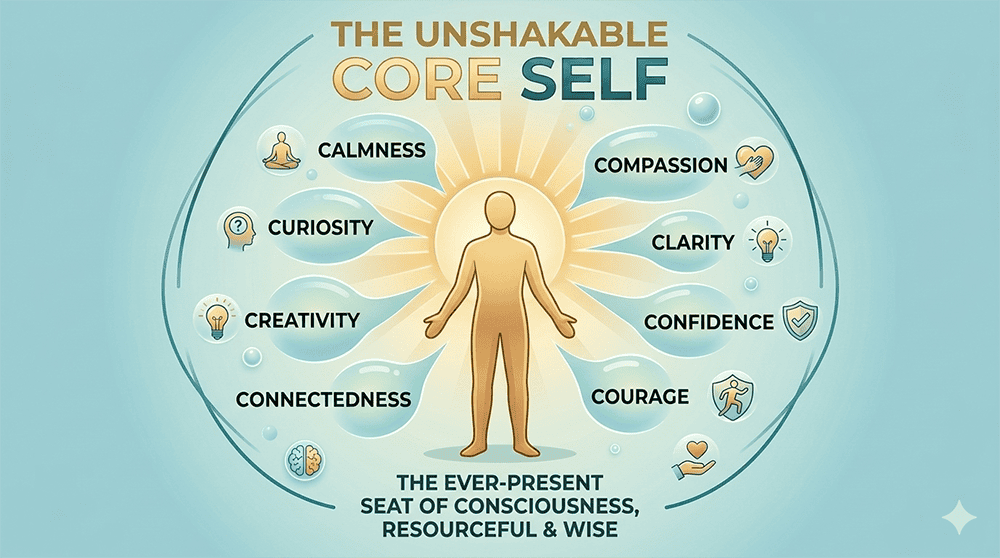
The concept of the “Core Self” is often buried under the noise of daily stress, limiting beliefs, and internal conflict. While many psychological models treat the mind as a single, often broken unit, the Inner Dynamic model—the cornerstone of the iNLP Center’s Mental Health Coach training—presents a more empowering reality. It posits that we are…
Continue Reading The Core Self: Parts Psychology and Neuro-linguistic Programming (NLP)

In professional development, there is a tendency to view “group dynamics” merely as the sum of several distinct personalities. However, expert facilitators understand that a team operates as a unified psychological ecosystem—a single organism with its own reflexes, language, and nervous system. When a team stagnates, it is rarely a talent issue; rather, the psychological…
Continue Reading NLP: A Blueprint for Advanced Group Coaching

The iNLP Center’s approach to Neuro-Linguistic Programming (NLP) places a strong emphasis on developing mental flexibility, also known as psychological or cognitive flexibility. This crucial skill is about the ability to adapt your thinking, perspective, and behavior in response to new information, changing circumstances, or challenging situations. It’s a cornerstone of resilience and success, allowing…
Continue Reading Developing Mental Flexibility by Learning NLP

Life is inherently unpredictable. Unexpected events, from natural disasters to personal setbacks, can disrupt our plans and challenge our emotional well-being. It is in these moments that resilience becomes a crucial asset. Resilience is the ability to bounce back from adversity, to adapt to change, and to persevere in the face of challenges. Building resilience…

If the relationship between a counselor and client is not strong, if rapport is not established, effective counseling is very unlikely to occur. To that end, NLP offers several strategies. To learn how to build rapport with clients more quickly, follow the guidelines in this short article. How to Use NLP to Build Genuine Rapport…

Neuro-Linguistic Programming (NLP) and Solution-Focused Therapy (SFT) are both powerful modalities that can be used to facilitate personal growth and change. Neuro-Linguistic Programming (NLP) Coaching NLP is a model of communication and personal development that explores the connection between the mind (neuro), language (linguistic) and the body (programming). It assumes that our thoughts, language, and…