
The concept of the “Core Self” is often buried under the noise of daily stress, limiting beliefs, and internal conflict. While many psychological models treat the mind as a single, often broken unit, the Inner Dynamic model—the cornerstone of the iNLP Center’s Mental Health Coach training—presents a more empowering reality. It posits that we are a system of “parts,” and at the center of that system lies an unshakable, resourceful Core Self.
This blog explores the architecture of the Core Self through the lens of Neuro-Linguistic Programming (NLP) and the specific “Inner Dynamic” framework used to facilitate lasting mental health breakthroughs.
The Multiplicity of Mind: A System, Not a Monolith
In traditional psychology, if you feel both “driven to succeed” and “paralyzed by fear,” it’s often labeled as clinical cognitive dissonance or a lack of willpower. The iNLP Center’s model reframes this as a natural Inner Dynamic. We are composed of various parts, each with its own history, triggers, and—most importantly—positive intentions.
Academic research into “Sub-Personalities” (Vargiu, 1974) and “Self-Complexity Theory” (Linville, 1987) supports the idea that a “multi-faceted self” is actually a sign of psychological resilience. However, when these parts are at odds, we experience an “inner tug-of-war.” The goal of coaching isn’t to eliminate these parts, but to move them into a state of congruence.
The Unshakable Core State
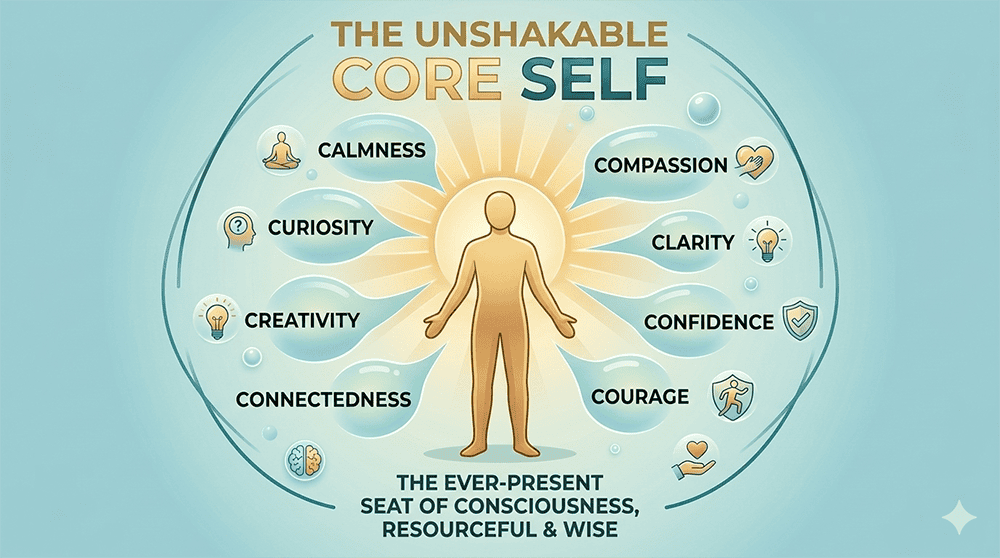
At the deepest level of the iNLP framework lies the Core State. While parts might be angry, anxious, or perfectionistic, the Core Self is characterized by qualities that are “unshakable” because they are not dependent on external circumstances. These include:
- Wholeness: A sense of being complete without needing to “add” anything.
- Inner Peace: A baseline of stillness regardless of environmental chaos.
- Presence: Being fully “in the now” without the distortion of past trauma.
In NLP terms, accessing this Core Self is known as “reaching the bottom of the chain.” When we ask a part what its ultimate goal is, and then ask what the goal of that goal is, we eventually move past “safety” or “approval” and land on a state of pure Being (Connirae Andreas, 1994). This is the Core Self.
The Inner Dynamic: From Conflict to Congruence
The iNLP Center’s Mental Health Coaching focuses on the relationship between these parts. Most mental health struggles stem from a part of the psyche taking on a “burden” or a “distorted role” to protect the individual.
1. The Positive Intention
A central tenet of NLP is that every behavior has a positive intention. A part that causes social anxiety might be trying to protect you from rejection. A part that drives overeating might be seeking a moment of comfort. By acknowledging the positive intention, we stop fighting ourselves. As the iNLP Center highlights, “taming the angry or rebellious parts” requires understanding them, not suppressing them.
2. The Tug-of-War
When two parts have conflicting strategies to keep you safe—such as a “High-Achiever” part and a “Self-Care” part—you experience burnout. The iNLP model uses Parts Integration to help these entities realize they share the same ultimate “Core State” (iNLP Center, 2024).
3. Integration and “Self-Leadership”
When a coach helps a client “unblend” from a part, they are moving the client into Self-Leadership. From the perspective of the Core Self, you can observe an anxious part with curiosity rather than being consumed by the anxiety. This shift is neurobiologically significant; it moves brain activity from the reactive limbic system to the executive functions of the prefrontal cortex (Siegel, 2010).
The Academic Foundation: Why This Works
The effectiveness of the Inner Dynamic model is rooted in several psychological pillars:
- Systems Theory: Viewing the mind as an ecology where changing one part affects the whole (Bateson, 1972).
- Neuroplasticity: By accessing Core States through NLP techniques, we create new neural pathways that bypass old, “stuck” reactive patterns.
- Congruence Theory: Based on Carl Rogers’ work, psychological health is defined as the alignment between one’s “Ideal Self” and “Actual Self.” The iNLP model facilitates this by bringing all parts into alignment with the Core Self.
Moving Toward Wholeness
The beauty of the Core Self is that it cannot be damaged. Trauma, stress, and life experiences may cover the Core Self—much like clouds cover the sun—but the sun remains.
The iNLP Center’s approach to mental health coaching is unique because it doesn’t treat the client as a “patient” with a “disorder.” Instead, it treats the client as a system in need of alignment. By using the Inner Dynamic model to negotiate between parts, we reveal the unshakable Core Self that has been there all along.
If you feel divided, it isn’t because you are broken; it’s because your “inner team” hasn’t yet learned how to communicate. By accessing your Core State, you move from a life of reaction to a life of intention.
References:
- Andreas, C., & Andreas, T. (1994). Core Transformation: Reaching the Wellspring Within. Real People Press.
- iNLP Center. (2024). Mental Health Coach Training and Certification. Retrieved from https://inlpcenter.org/mental-health-coach-training-and-certification/
- Linville, P. W. (1987). “Self-complexity as a cognitive buffer against stress-related illness and depression.” Journal of Personality and Social Psychology.
- Siegel, D. J. (2010). Mindsight: The New Science of Personal Transformation. Bantam.
- Vargiu, J. (1974). “Subpersonalities.” Synthesis Journal.