We inhabit a quiet crisis of the middle ground. In the modern landscape of personal development, a specific tension has emerged: many of us find ourselves “functional” yet far from “optimal.” We manage our daily responsibilities—we show up to work, maintain our families, and keep up appearances—but there is a persistent sense of being unaligned, stuck, or internally conflicted. We are no longer looking for permission to exist; we are looking for the tools to thrive.
This search for optimization is a response to a major shift in mental health over the last thirty years. During this time, the field moved heavily toward clinical disorders and the prescription of medication for chemical imbalances. While vital, this clinical paradigm often pushed aside effective, non-clinical approaches. It created a significant gap for those who do not require a diagnosis but do require transformative support to navigate their “Inner Dynamics.”
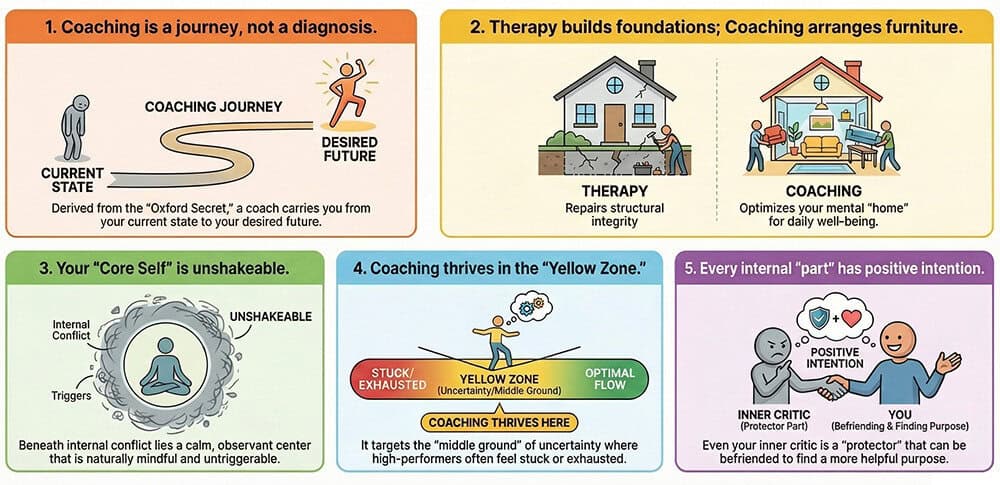
The following five truths reveal how the new frontier of mental health coaching is filling this gap, moving beyond traditional therapy to help individuals achieve internal congruence and extraordinary results.
1. The Oxford Secret: Coaching is About the Journey, Not the Diagnosis
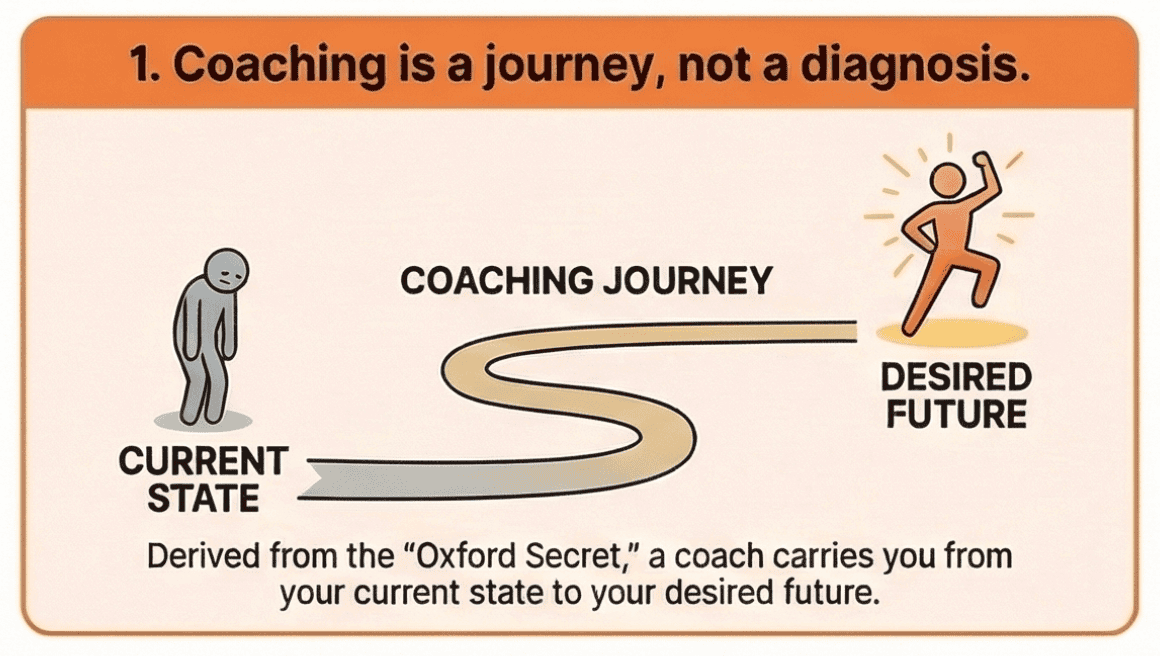
The term “coach” carries a history that most people overlook. Around 1830, Oxford University slang used the word to describe a tutor who “carried” a student through an exam. Much like a physical carriage, the role was designed to transport a person from where they are to where they want to be.
This relational perspective is the heartbeat of mental health coaching. Unlike the clinical model, which focuses on identifying what is “wrong” through a diagnostic lens, coaching is a partnership centered on action and self-understanding. It assumes that the answers lie within you, and the coaching relationship provides the safe, quiet space required to bring those answers to the surface.
Coaching is a powerful relationship that helps people produce extraordinary results in their lives, careers, or relationships. The process is designed to help clients get from where they currently are to where they would prefer to be.
2. Coaching vs. Therapy: Foundations vs. Furniture
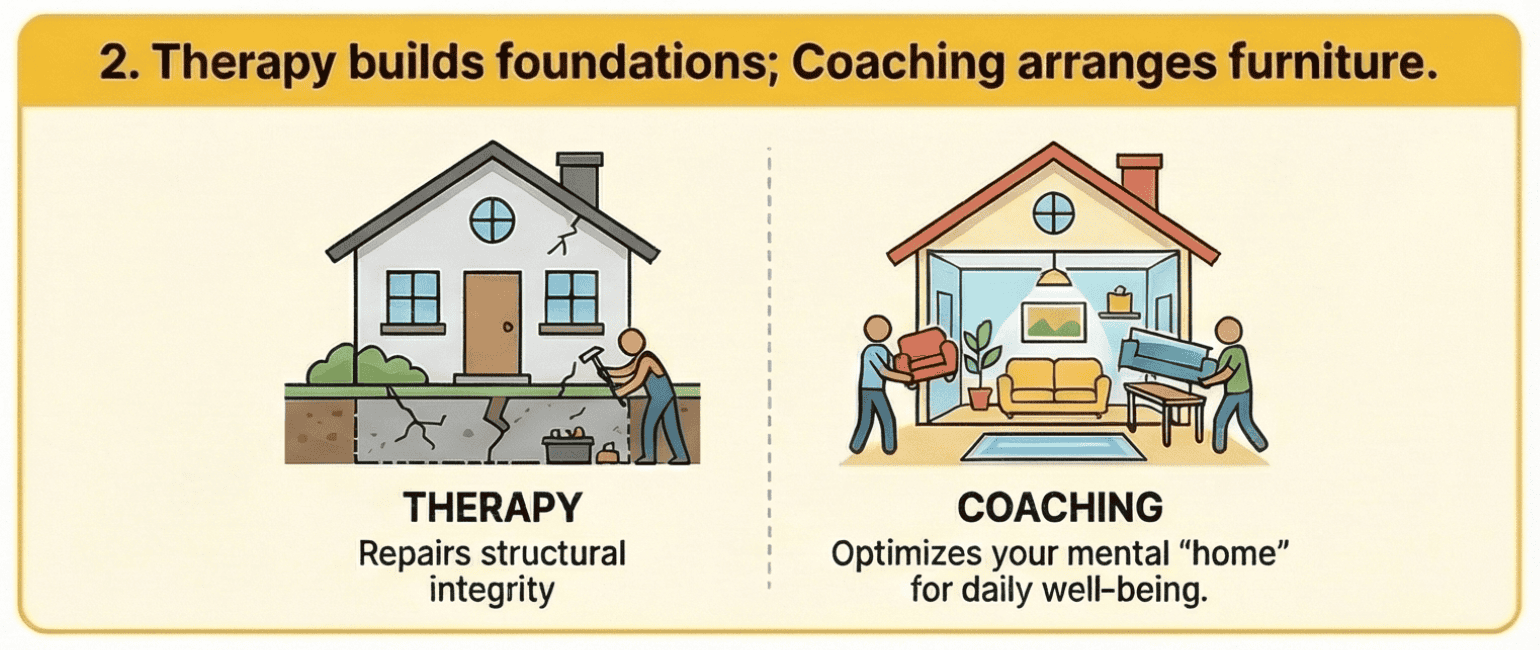
To understand the difference between these two vital fields, we can look at the psyche as a house. Therapy is structural work. It is concerned with the structural integrity of the building, addressing “termites,” stabilizing the foundation, and resolving “hidden” elements from the past that threaten the home’s stability.
Coaching, by contrast, is the “Feng Shui” of the mind. It is about optimizing the home we live in right now. It involves painting, decorating, and rearranging the layout to ensure the space is functional and aligned with how we want to live. While therapy provides the stable base, coaching focuses on the “present and future,” helping you achieve life goals and enhance daily well-being. Both are necessary, but they serve different roles in the architecture of a healthy life.
3. The Calm Center: You Have an Unshakeable “Core Self”
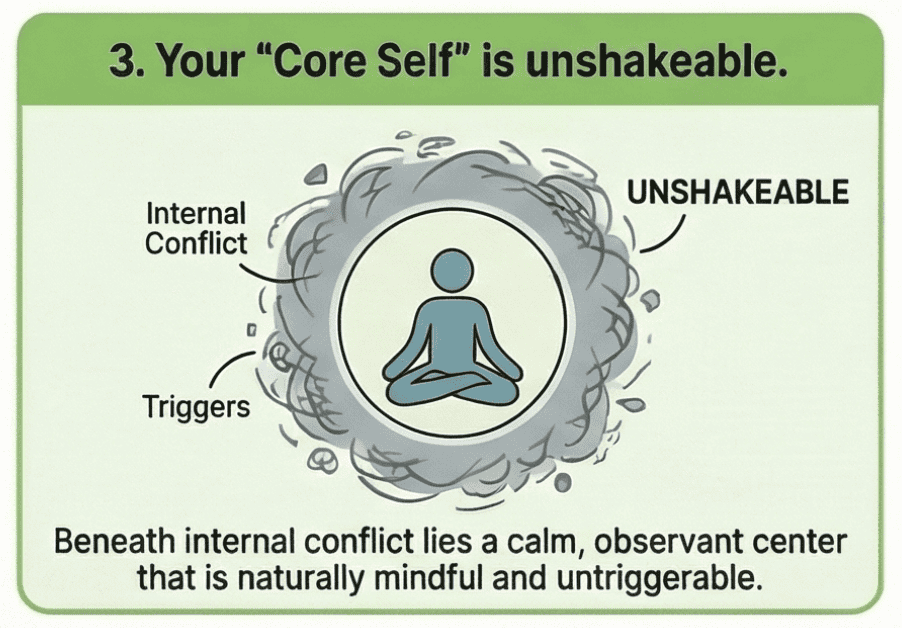
One of the most profound realizations in integrative psychology is the existence of the Core Self. Even when we feel overwhelmed, the Core Self is always in the background, a silent and steady witness. We define the Core Self through sensory-based language: it is the visual clarity of an open gaze, the auditory calm of quiet internal dialogue, and the kinesthetic weight of a grounded, settled nervous system.
A central concept in this work is “Hijacking.” When we are triggered, it isn’t “us” reacting; it is a “part” that has associated into our experience and taken over the mouthpiece. The Core Self, by definition, is actually untriggerable. It is the expansive part of you that remains in a mindful state, even when a protective part is screaming for attention.
The Qualities of the Core Self include:
- Visual: Clear, mindfully present, and observant.
- Auditory: The steady, quiet resonance of compassion and curiosity.
- Kinesthetic: Grounded, resourceful, and settled in the body.
- Perspective: Fair-minded, operating at your current age, and non-reactionary.
4. Navigating the Yellow Zone: The Middle Ground of Mental Health
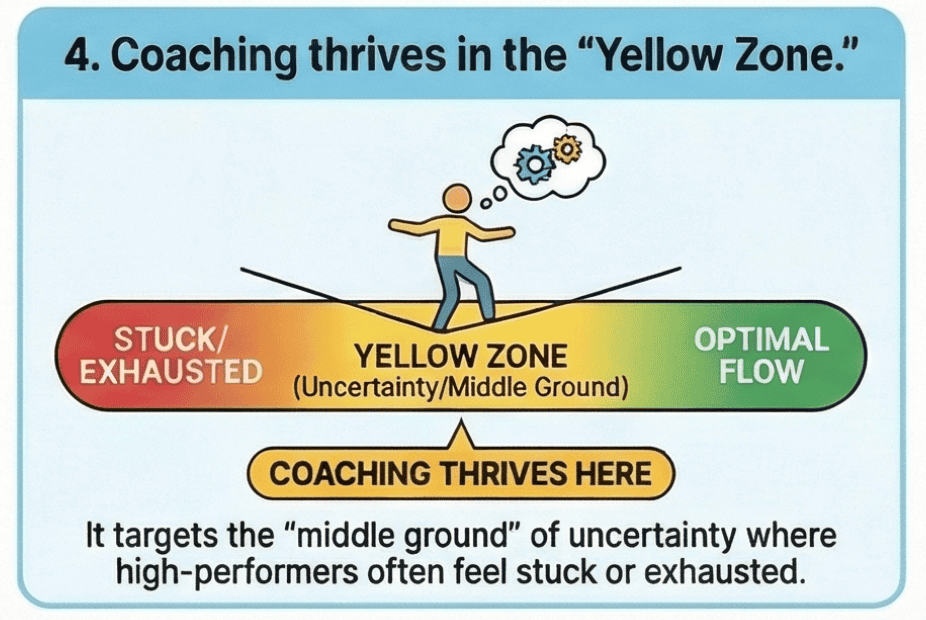
In the iNLP Center’s coaching model, we utilize a Functionality Scale to measure how much an issue disrupts your life:
- Green Zone: High functionality. Life is working, though perhaps not optimal.
- Yellow Zone: The middle ground marked by uncertainty.
- Red Zone: Low functionality. Major life areas (work, hygiene, social) are significantly disrupted.
The Yellow Zone is where most high-performers reside. It is often a “blended state” that feels like an engine revving while the car stays still: you have one foot on the gas (the sympathetic “fight/flight” drive) and one foot on the brake (the dorsal “shutdown” response). This is exhausting.
Coaching thrives here. The coach acts as a “systems-checker,” helping you recognize your Window of Tolerance. By providing the tools to unblend from these states, coaching moves you back into Ventral Vagal safety—the calm, social state where you can finally take the parking brake off and move forward.
5. Radical Compassion: Every “Part” Has a Positive Intention
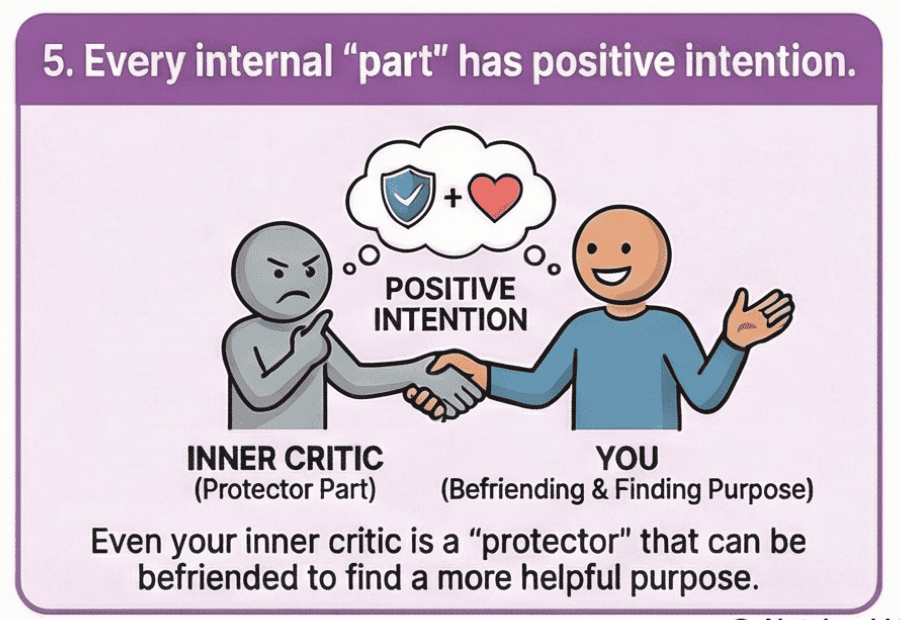
A cornerstone of Inner Dynamics is the principle that there are no “bad” parts of you. Every aspect of your psyche—even the inner critic or the procrastinator—has a Positive Intention based on what it knows. Often, these parts act as “Protectors,” but they are working with outdated information.
Protector parts often act based on past experiences. A part that is overly critical may actually be trying to help the client avoid future pain, seeing the Core Self as a vulnerable child that still needs shielding, rather than the capable adult they have become.
Rather than trying to “kick out” these parts, we use the 6 F’s: Finding, Focusing, Fleshing out, Feeling toward, Befriending, and Finding out the fear. When a part feels seen and validated by the Core Self, it often spontaneously discovers a new, more helpful purpose for the present day.
The Path Forward
NLP-integrated, trauma-informed parts work is more than a technical skill; it is a journey of self-exploration. By understanding the Functionality Scale and learning to unblend from hijacked states, we can lead lives of greater congruence and resilience.
As you reflect on these truths, ask yourself: Which “part” of me is currently leading my life, and is it ready to let my Core Self take the wheel?
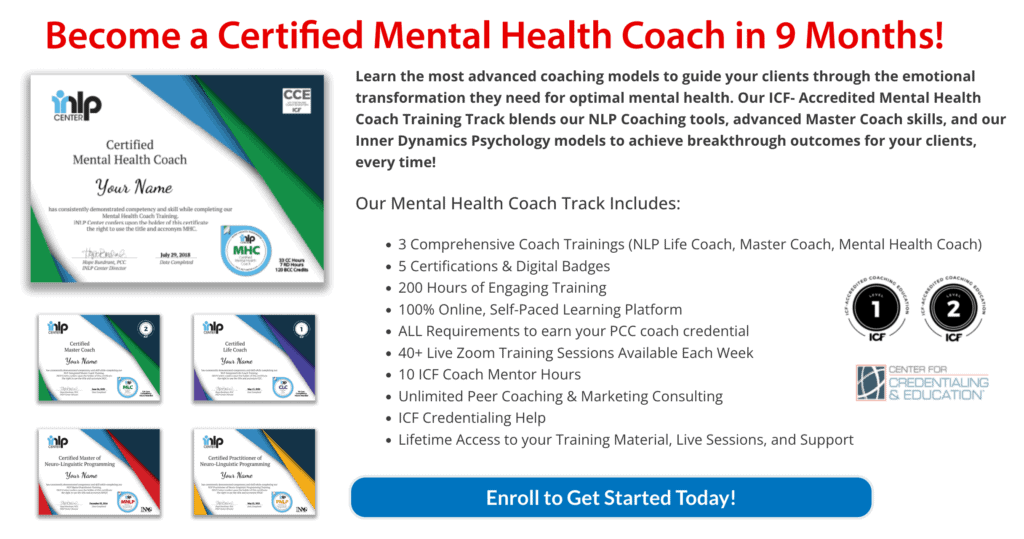
If you are ready to master these advanced models and guide others through this emotional transformation, the iNLP Center provides a comprehensive Mental Health Coach Training Track. This 9-month, 100% online program is designed for maximum flexibility, offering deep immersion into the Inner Dynamics and Polyvagal tools necessary for the new frontier of mental health.