
NLP Training from the World’s First & Best Online NLP Institute
NLP Training & Certifications:
Practitioner & Master Practitioner Levels
Learn in a flexible online format with the supervision you need to master the NLP models and grow your skills. Practice in small-group Zoom sessions, get feedback on your activities, and apply your learning in everyday life.
Your NLP Training Includes:
• Get started immediately: enroll and access your training right away.
• Learn at your pace: no completion deadlines or expiration.
• 8 weekly live class options: small-group NLP training with real trainer interaction.
• Practice and get feedback: guided activities and student practice opportunities.
• Unlimited peer coaching to build experience and confidence.
• Lifetime access: course materials and live training, even after graduation.
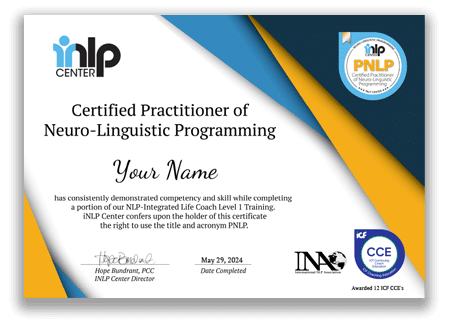
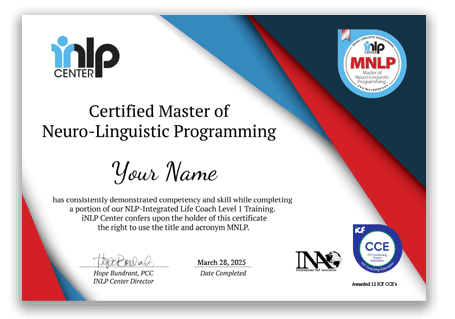
• Earn your certification: digital badges and certificates included.
Accredited by:
ICF International Coach Federation
International NLP Association

Your life is your classroom
Why is our NLP Training So Effective?
Practical Coaching Skills, Not Just Magic Bullets!
We teach NLP from a grounded, coaching-focused perspective that allows learning the models and techniques from a practical foundation, not as a quick, “magical” cure.
Get to know your trainers in small-group Zoom sessions, practice with friends and fellow students, and receive real feedback on your assigned activities. Lifetime course and live-session access give you room to keep learning.
Practical learning
Build Your NLP Skills Through Real-Life Practice
Put each new NLP skill into practice through three types of activities. Explore your own patterns, notice what happens in everyday interactions, and practice with others—with trainer feedback to help you develop.
Required offline activities help you practice your new NLP skills, report on your experiences, and integrate your learning into daily life.
Psyche Builders
Explore your own experience and build self-awareness through the course’s personal learning activities.
Stealth Missions
Take your learning into everyday life and notice how NLP patterns appear in real interactions.
Coaching Exercises
Practice the models with others, reflect on what happens, and receive feedback as your skills develop.
Learn with people, not just a screen
Live NLP Training.
Included for Life!
Our live sessions complement your self-study work with Q&A, demonstrations, student practice, and deeper discussions.
- Work with trainers in small-group Zoom classrooms.
- Connect and practice with fellow students worldwide.
- Continue attending after you graduate.
Attend when it works for you.
Weekly class times · Pacific Time
Monday | 2am · Every other week at 5pm |
Tuesday | 12:45am · Every other week at 4pm |
Wednesday | 3am and 6am |
Thursday | 10am |
Friday | 5am |
Saturday | 3am |
Sunday | 4pm |

“I have enjoyed this course and found it both practical and engaging. The training helped me to build a strong foundation in the NLP concepts and techniques, while also giving me opportunities to practice and apply what I have learned. What I appreciated most was the supportive learning environment, the live sessions, and the focus on real-world application rather than just theory. The course has increased both my confidence and my interest in NLP.”
– Cristina L., iNLP Center student
Build your NLP foundation
What’s Covered in our NLP Practitioner Certification Training:
Explore the models, practice the techniques, and integrate your skills through real-life activities.
Module 1: NLP Fundamentals – Your Mind at Work
- Learn the three primary ways to create your desired state
- Develop sensory acuity and behavioral flexibility.
- Explore resourceful states and the fundamentals of NLP.
- Learn and interpret the NLP Presuppositions.
Read more
Neuro-linguistic programming aims to move from your present state (or mindset) if it is useful to do so – to a more desired state in which you have more resources. NLP tools can help you accomplish that. Learn the three primary ways to do this.
Learn the definition of sensory acuity, the classic NLP skill you will use to make unique observations throughout the course. Behavior Flexibility will increase your awareness and help you identify areas where you do not have as much choice as you want. States of Excellence is another classic NLP concept that drives you to maintain your best state of mind and body for every situation.
Our rare learning perspective will establish the most productive frame of mind for learning in a way that leads to continual discovery.
Module 2: VAK Representational Systems & Eye Accessing Cues
- Notice sensory language and communication preferences.
- Practice the VAK model and eye-accessing-cue exercises.
- Effectively communicate with a greater variety of people
- Learn to read others with accuracy
Read more
Learn the most influential aspects of non-verbal communication through the visual, auditory, and kinesthetic modalities.
Discover the common words and phrases that give away which VAK modality people use. Discover how people are thinking based on their eye movements. When you notice this deeply unconscious pattern, you will know more about how people think than others realize is possible.
Apply your VAK awareness to solve problems in the most effective way for you and help others do the same. Your preferred mode of communication and that of others are revealed.
Learn how to connect with anyone based on unconscious preferences.
Module 3: Rapport and Other People
- Explore the six elements of rapport.
- Practice matching, mirroring, and observing interactions.
- Create rapport with more people
- Become a master of non-verbal communication
Read more
Non-verbal communication and rapport are the primary basis for building rapport with anyone in any culture.
You will learn the basic aspects of non-verbal communication, how to use them effectively, and the six elements of non-verbal communication that establish rapport, so you can build a connection quickly with most people.
Classic NLP matching and mirroring exercises allow you to hone your skills. These neurolinguistic programming skills lead to influencing with integrity and noticing when you have established rapport and trust with another person.
Module 4: NLP States
- Learn anchoring and association/dissociation.
- Gain greater self-control of emotional states.
- Overcome negative emotions and release negativity in the past.
- Learn new behaviors and skills quickly.
Read more
Learn the most effective methods for entering any psychological state at will using a classic NLP technique to strengthen and stabilize resource states and works like no other psychological intervention.
Learn anchoring to resolve stuck states and problems by automatically applying resources to negative thoughts and emotions.
The New Behavior Generator combines the power of visualization with the refinement of NLP to make new behaviors simple and build skills quickly.
Discover how to turn any negative situation into an automatic learning experience and draw from the best positive experiences from the past using NLP Association/Dissociation. This exercise is among the most popular in our course, as it reveals the thought structure of optimism and pessimism.
Module 5: NLP Strategies
- Explore decision-making and motivation strategies.
- Make better decisions with confidence
- Motivate yourself easily to do necessary but unpleasant tasks
- Understand how to create mental strategies for success
Read more
You will learn the modeling patterns that put NLP on the map. Using VAK skills learned in earlier modules, a new world of thought processes will unfold before you. You’ll find out how results are created internally before they happen outwardly. Then, you will discover how to rearrange a strategy to produce far better results.
This classic NLP strategy is simple to learn and improves spelling quickly and dramatically for those who need it.
What makes a good decision? How are bad decisions accomplished? A new world of inner processes is explored that determines how decisions are made, specifically. This allows you to analyze decisions like never before and implement solid decision-making processes into your life.
With the same underlying NLP strategy principles, learn the four negative motivational styles and the solution to each one. Discover how to help anyone, including yourself, resolve problems with self-motivation!
Module 6: The Meta Model
- Recognize common language patterns and assumptions.
- Cut through the clutter to understand complex situations in minutes.
- Gain critical insight when no answers seem obvious.
- Effectively deal with your own internal dialogue
Read more
The NLP Meta Model was the subject of the first NLP book. It has remained among the most important foundational tools for any expert communicator.
The neurolinguistic programming meta model is a tool for helping yourself and others become aware of the underlying meaning of any vague communication.
The Meta Model is a linguistic model. Many people who have learned NLP have shied away from the linguistics aspect because it can be difficult to learn.
At the iNLP Center, we have broken the Meta Model into small chunks that are easy to digest and fun to learn. Within minutes, you will learn how to quickly get to the heart of the matter in any interaction, including those within your own mind.
Module 7: Exploring Submodalities
- Notice how experiences are represented internally.
- Develop inner resources to overcome fears, phobias, and stuck states quickly.
- Gain mental flexibility and quickly change perceived limitations
- Explore Map Across, the Swish Pattern, and other submodality work.
Read more
Learn how VAK submodalites are the building blocks of subjective experience. These unconscious distinctions are a big eye-opener for many of our NLP students. Once understood, you can rearrange your inner world in the same way you would rearrange building blocks. Create the state of mind you want, at any time, regardless of what you happen to be thinking or feeling.
You will soon discover that what you are thinking and feeling is not nearly as important as how you are thinking and feeling. Most people can tell you what they are thinking. Fewer people can tell you how they are thinking it. This is the difference that makes all the difference!
The NLP Map Across is a classic submodality invention that allows you to transform any negative state into a resourceful state by shifting the VAK submodalities.
This pattern eliminates unwanted habits and behaviors by reversing key thought patterns and simultaneously installing new inspiration into your mind. Not only will your rigid patterns of behavior be interrupted, you will also find the motivation to change them with this technique.
Another famous NLP technique, the Fast Phobia Cure is a specific submodality process that neutralizes most simple phobias in about 60 seconds.
Module 8: The Milton Model
- Gain greater influence and persuasive power.
- Encourage change without prying into content.
- Help others access internal resources.
- Gracefully guide people through problems and decision.
Read more
The Milton Model is the inverse of the Meta Model. It is patterned after the hypnotic techniques of Milton Erickson, MD, known as the most influential practitioner of medical hypnosis in modern history.
The Milton Model teaches you the language of influence: how to motivate, inspire, and create change just by using words in a chosen pattern.
Again, we have taken the time to break down these linguistic concepts into easily manageable learning chunks so that the skills can be years without confusion or overwhelm.
The NLP Process Instruction Exercise can be used to inspire automatic change without knowing the content. In other words, you can guide someone to choose a problem and then solve it without knowing what problem they are working on.
Understanding the Milton Model is the key to this kind of work. The neurolinguistic programming Process Instructions Exercise shows you specifically how to do it.
Module 9: Creating Outcomes with NLP
- Gain clarity on any goal or desired outcome
- Connect clear outcomes with practical steps and sensory awareness.
- Greater confidence in pursuing goals by identifying and overcoming personal obstacles
- Learn what you specifically want from your life!
Read more
NLP Outcome Specification is a comprehensive model that asks all the right questions to set anyone up for success in achieving goals or therapeutic outcomes. You will learn the common pitfalls among people who do not do well when accomplishing goals, and how to get the right information to begin any journey toward greater success.
Whether or not you believe in new age principles, A Formula for Manifesting is a unique process that will guide you through reality-based steps that utilize Outcome Specification and VAK principles to manifest your goals.
The exercises invite you to move beyond a general wish and describe what you want with greater specificity. You will consider the outcome in context and explore how you would recognize progress, rather than relying on an inspiring goal statement alone.
Module 10: Perceptual Positions
- Detect critical patterns in relationships.
- Develop greater emotional maturity and empathy.
- Practice perspective-taking through guided exercises.
- Solve misunderstandings quickly.
Read more
According to classic NLP, there are three points of view in any relationship. Learn these points of view, then use them to resolve issues by changing positions. With this neurolinguistic programming model, your relationships will become more interesting, and problems will seek their own solutions.
Through this model, you will notice differences between your own experience and your interpretation of another person’s experience by using the observer position to reflect on an interaction with more distance. You’ll then be able to bring your observations back into everyday communication and practice conversations.
In the module exercises, you will move deliberately between perspectives and compare the observations available in each. Sentence-completion and practice activities help you examine how your interpretation of an interaction changes when you shift your point of view.
Module 11: Reframing with NLP
- Redefine any situation to make it useful and productive.
- Change impossible behaviors where your choices are limited.
- Practice meaning reframing and create meaning consciously.
- Develop world-class mental flexibility and insight.
Read more
In NLP, we understand that all meaning is malleable. You can change the meaning of almost anything. When you get stuck, it is often because your ability to change meaning is limited.
The NLP reframing models allow you to change meaning by choice, not by chance, to change unwanted habits, feelings, and all manner of rigid thoughts and behaviors – even physical symptoms yield to the six-step reframe.
Meaning-reframing activities invite you to consider another way of interpreting a situation. The Six Step Reframe is then taught step by step, with personal reflection and coaching practice to help you work through the process rather than memorize its name. You’ll learn how to distinguish an event from the meaning you give it. This allows you to explore alternative interpretations without dismissing the original experience.
Module 12: The Timeline Technique
- Change your perception of the past and future to suit your needs and desires.
- Connect future-oriented reflection with a desired outcome.
- Feel greater excitement, curiosity, and self-confidence.
- Let go of the past and program your future for greater success
Read more
NLP Timeline reveals your subjective experience of time. You will discover how you organize your past and future memories in your mind. Once you understand this, you will be ready to take control of both the past and future. Learn to modify your sense of the past and future in a way that serves you better and helps others do the same.
Use NLP Timeline to create the future you want and release the old limitations you had on it that you did not even know were there! You will explore how past and future are arranged in your subjective experience and notice the distinctions that make your timeline meaningful to you. Coaching and personal practice activities provide opportunities to work through elicitation and reflect on how your sense of the future relates to your goals.
Expand your understanding
Explore Our NLP Master Practitioner Training:
Our NLP master practitioner training offers unique models of human development and communication that put NLP techniques in a useful context.
Module 1: Psychological Levels of Development
- Consider how development informs your choice of approach.
- Connect developmental understanding with practical work.
- Know where you are and what you need to do as an adult interested in growth.
- Understand what to help people with and when.
- Be able to address your own and clients’ deepest psychological needs.
Read more
It is easy to understand that a small child of five does not possess the same knowledge, skills, and awareness that a mature adult of 50 has. Between five and 50 are years of learning and experience for which there is no substitute. To achieve a similar degree of development as a mature adult, there seems to be no choice but for the child to go through a similar number of years, adding to his experience and awareness along the way.
Any methodology intended to help people would benefit from this developmental understanding of the maturation process. Many authors and researchers have written on this subject in psychology. iNLP has synthesized the work of the foremost developmental theorists into a model that we teach in our public training and use in our private work with people.
Understanding where someone is in the larger course of their life illuminates how to work with them. This includes knowing which goals to set, which techniques to use, and what results to expect.
Module 2: The Physiology Map
- Explore internal and external points of reference.
- Consider possible directions for greater flexibility.
- Know specifically what you need to do to get unstuck.
- Develop strategies to achieve positive emotional states.
- Understand where conventional wisdom fails to create lasting emotional flexibility.
Read more
The Physiology Map is a model developed by NLP Santa Fe and the iNLP Center. The Physiology Map tracks emotions, or physiological states, which we consider to be one and the same. Each physiological state we experience has certain qualities or characteristics.
With this model, we attempt to classify those characteristics. The Physiological map implements the concepts of Associative/Dissociative and External/Internal to map one’s emotional state into quadrants. When we understand the Physiological Map and its implications for human behavior, it becomes clear how to use this NLP model to help people and ourselves move in useful directions.
Module 3: The Twelve States of Attention
- Explore twelve combinations of sensory attention.
- Practice noticing and shifting your attentional focus.
- Radically increased visual, auditory, and kinesthetic flexibility.
- Ability to access VAK places where it is impossible to get stuck.
Read more
As you will learn, NLP emphasizes three sensory systems: visual, auditory, and kinesthetic (seeing, hearing, and feeling). Each system is known as a modality. Using traditional NLP, we go beyond analyzing what we are thinking or experiencing by learning how our thoughts and experiences are structured in our brains. Understanding this structure and how to influence it gives us monumental advantages.
Beyond seeing, hearing, and feeling, the broad-narrow and internal-external sensory distinctions add a new level of sophistication to the VAK model. These two additional sensory distinctions are probably more important to our psychological functioning than seeing, hearing, and feeling alone.
Module 4: The Quad Map
- Notice where attention is directed during a conversation.
- Explore alternative questions and points of focus.
- Gain more control of your mind and attention.
- Develop the ability to get unstuck quickly.
- Get to a positive mental outcome efficiently, regardless of the starting point.
Read more
Our minds are constantly in motion, remembering past experiences and imagining future experiences. It is interesting how little time we spend in the present moment, with our attention directed fully toward the external world. So often, we are inside our minds, attending to the inner life. How we direct our attention influences so much of our experience, both positive and negative.
The questions we ask and the comments we make invite others to direct their minds in ways that will be helpful, productive and positive, or not. Understanding the Quad Map gives us a significant advantage when communicating with others.
Module 5: Criteria for Psychological Safety
- Explore the relationship between safety and change.
- Consider goals that respect individual needs and boundaries.
- Feel safer every day.
- Enhance confidence and motivation.
- Develop clearer decision-making and prioritizing.
Read more
Emotional safety is primal. If we do not find a way to feel safe each and every day, we cannot accomplish much beyond reacting to the vague yet constant threat. Most of our life is geared towards reducing anxiety and getting to a place where we feel safe.
Worse, we often put ourselves in threatening situations in the name of personal growth. Too many personal growth advocates push people to break far out of their comfort zone. Expand beyond your limits, destroy obstacles, and succeed beyond your wildest expectations! This is a terrible setup that is destined to fail.
Suddenly expanding beyond perceived limitations, which are psychological protections, brings fear of the unknown, sending the old brain into a tailspin. If it were possible to suddenly destroy your every psychological defense mechanism and wildly expand your boundaries to include all sorts of unfamiliar experiences, you would experience an incredible rush of panic.
A quest for inner peace and personal development should honor the need for emotional safety. You are wired for personal safety, and your personal development plan needs to be equally wired! If not, you are picking a fight with your old brain, and you will lose.
Module 6: Metaphoric Intervention
- Identify a personal life metaphor.
- Explore the meaning and implications of different metaphors.
- Align yourself with the most meaningful and powerful way for you to view life.
- Discover your personal metaphor.
- Create new lenses to view areas of your life.
Read more
Our concept of existence is metaphorical in nature. We can only comprehend life, objects, and ourselves by association, which is the broad meaning of metaphor – to understand one thing in terms of another. The Earth is a tiny ball floating through space. Associating the earth with a floating ball helps us put things in a context that fosters understanding. Here are some other examples:
The brain is like a computer; life is a test; college is like a 24/7 party; time is money; argument is war.
The metaphor we choose or inherit, often deeply unconscious, holds tremendous power over how we feel, think, behave, and interact with other people.
This module will help you discover your personal life metaphor and show you how to change it, if necessary, to something deeply empowering.
Module 7: Core Transformation
- Follow the process through a video demonstration.
- Practice the steps and reflect on your experience.
- Develop deep self-acceptance.
- Tame the angry, rebellious, hidden, or outcast parts of yourself.
- Experience your core state for perhaps the first time.
Read more
The Core Transformation method is one of the deepest and most sophisticated processes in the field of NLP. The method was developed by Connie Rae Andreas, who has given the iNLP Center permission to teach it.
The goal of Core Transformation is to help one reach their core state, which is a state of wholeness, oneness, peace, or connection to the universe. As you work your way up and down the steps, you will see that you can access your core state at any moment. Every step of the process leads toward that state of wholeness.
In this module, we break down the steps. The video demonstration shows each part of the process, so you can replicate it with a client. The exercises featured in this module allow you to try it with a friend and work on yourself.
Module 8: The Default Mode Network
- Reflect on patterns of inward attention and preoccupation.
- Consider how attention relates to your experience of the present.
- Experience dramatic and immediate stress reduction.
- Gain a mindfulness tool to live in the moment.
Read more
Sometimes, it may seem like a little demon is inside your brain, making you feel tense and miserable. Well, there is! When active, your brain has an internal network, the Default Mode Network (DMN), that continually generates an ocean of mental activity and body tension. The DMN never stops churning unless you are purposefully engaged in a particular cognitive task. When your task-oriented mind is resting, the DMN is working overtime. This is a proven scientific fact that has been validated via fMRI scans.
When the DMN is overactive, common today, it is like a digital clock that blinks the word stress incessantly. You move throughout your day on autopilot, churning, grinding thoughts, and body tension ruling your awareness. Your stress and preoccupation get in the way of dealing with others, getting work done and even sleeping.
Module 9: Meta Programs
- Recognize patterns in motivation and decision-making.
- Consider how your communication can respond to different filters.
- Understand key drivers of human behavior.
- Become better at influencing others with integrity.
Read more
In NLP, meta programs are information filters. They are mental sorting devices that determine which information to keep, which to ignore, which to act upon, and how to act.
Meta programs guide decisions and behaviors. Some meta programs are so powerful that they can almost seem like personality traits. They are not, though. They are simple filters that guide us through a world of information. Most often, meta programs are deeply unconscious. They do their work under the surface and are rarely discovered by people (who are typically studying NLP).
When you understand key meta-programs, you gain an unusually powerful insight into human behavior, decision-making, motivation, communication styles, and more.
Module 10: Presuppositions
- Identify what a statement assumes to be true.
- Practice examining assumptions and considering alternatives.
- Understand the limited assumptions others make and turn them into breakthroughs.
- Tailor your communication to empower others.
Read more
Presuppositions are the linguistic equivalent of what most people call assumptions. Presuppositions refer to what must already be assumed to be true for the question or statement to make sense.
Presuppositions are typically not stated directly. The are hidden assumptions in conversation.
Every sentence we speak in everyday life contains presuppositions. In most cases, we tend not to consciously recognize what we have presupposed and concentrate on what is directly stated.
Therefore, presuppositions are unconsciously accepted as being true. This often has a direct impact on behavior, whether or not the assumption is accurate.
The module moves from recognizing basic presuppositions to practicing how to challenge, reverse, and create them. You will explore the difference between what a person directly says and what their statement asks the listener to accept without discussion.
Module 11: Logical Levels
- Study the model’s categories through examples.
- Connect your observations with possible approaches.
- Help people in the most efficient, effective way and with the highest amount of leverage.
- Know where to intervene and what tools to use.
- Create a path forward focused on the areas of need.
Read more
The classic logical levels model, as introduced by Gregory Bateson, has long served as a guide for practitioners to know how to intervene. In this module, you will learn the nuts and bolts of Logical Levels. It will answer questions that you never thought to ask, such as:
Why are some behaviors so hard to change, and what can you do about it?
Where is the most efficient and effective place to intervene when someone presents a problem?
Where is the highest leverage place to intervene?
Examples in the module help you apply the categories to a situation rather than treat them as abstract labels. The accompanying reflection and coaching exercises invite you to consider how the way a problem is described influences the questions you ask and the tools you choose.
Module 12: Module Integration
- Develop an integrated approach to a personally relevant outcome.
- Connect concepts from earlier modules to the outcome you want to explore.
- Translate that reflection into a practical plan for continued application.
- Develop a road map toward a specific, large-chunk goal in your future.
Read more
You will apply everything you have learned thus far in the training to this goal, dramatically increasing your chances for success and ensuring that the next period of your life will be filled with personal growth and empowerment.
You will also record an NLP session with a volunteer and submit it to demonstrate your Master NLP skills.
This final module brings the course models into one practical application. You will use a specific, personally meaningful outcome to organize your learning, consider which approaches fit, and develop a road map for applying them.
NLP TRAINING & CERTIFICATION
Choose an NLP Training
Build your foundation with NLP Practitioner training, continue into Master Practitioner, or combine NLP with professional life coach training. Enroll and get started immediately.
NLP Practitioner
Training
YOUR NLP FOUNDATION
1 course · 1 certification
Explore included courses
- NLP Practitioner Training
- Personal Development Program included
View certifications
- NLP Practitioner
Training program | 50 hours |
ICF training hours | 12 hours |
Learning format | Online & self-paced |
Includes live NLP training and lifetime access.
PAY IN FULL
$499 USD
Already NLP Practitioner certified? Take NLP Master Training separately for $599 USD. Prerequisites apply. Contact us
NLP Practitioner
& Master Training
FOUNDATION + ADVANCED LEARNING
2 courses · 2 certifications
Explore included courses
- NLP Practitioner Training
- NLP Master Practitioner Training
- Personal Development Program included
View certifications
- NLP Practitioner
- NLP Master Practitioner
Training program | 90 hours |
ICF training hours | 24 hours |
Learning format | Online & self-paced |
Includes live NLP training and lifetime access.
PAY IN FULL
$899 USD
PAYMENT PLAN
4 monthly payments of $249 USD
Total: $996 USD
NLP-Integrated
Life Coach Training
NLP + PROFESSIONAL COACHING

1 training track · 3 certifications
Explore included courses
- NLP-Integrated Life Coach Training
- 10 hours of ICF mentor coaching
- Business & marketing training
- Personal Development Program included
View certifications
- NLP Practitioner
- NLP Master Practitioner
- Certified Life Coach
Training program | 150 hours |
ICF mentor coaching | 10 hours |
Completion | From 3 months |
Explore the complete Life Coach training page for all enrollment options.
Train Your Way
Flexibility and ongoing support – included with every track!
- Self-paced learning
- No completion deadlines
- Lifetime training access
- Unlimited reciprocal peer coaching
FAQ’s about our NLP Trainings
Have questions about our NLP Training Programs?
Let’s talk about your goals and the training that fits your next step.